

Brand Stories
What Is BIO EVA? Can Sugarcane Plastic Save the Planet?

Oct
Every time we buy a new pair of sandals, we may unknowingly increase our dependence on fossil resources. Behind the comfort and lightweight design of modern footwear lies a complex combination of synthetic materials. Many originate from petroleum and natural gas, resources that nature cannot replace within a human lifetime.
The problem extends far beyond a single pair of shoes. The global footwear industry produces enormous quantities of products, many of which combine materials that are difficult to separate and recycle. Once consumers discard them, these materials can remain in waste streams for years.
This raises an important question: Can we continue creating beautiful, comfortable footwear while reducing our dependence on fossil-based plastics?
One promising answer is BIO EVA, or Bio-Based Ethylene Vinyl Acetate. This material uses renewable resources such as sugarcane to replace part of the fossil-derived ingredients traditionally used in plastic production.
For Sandals World, BIO EVA represents an opportunity to explore new materials while continuing to celebrate Thai craftsmanship, creativity, and local communities.
However, important questions remain. What is BIO EVA? How does sugarcane become plastic? Can it genuinely reduce environmental impacts? And what does this innovation mean for Sustainable Thai Craft Sandals?
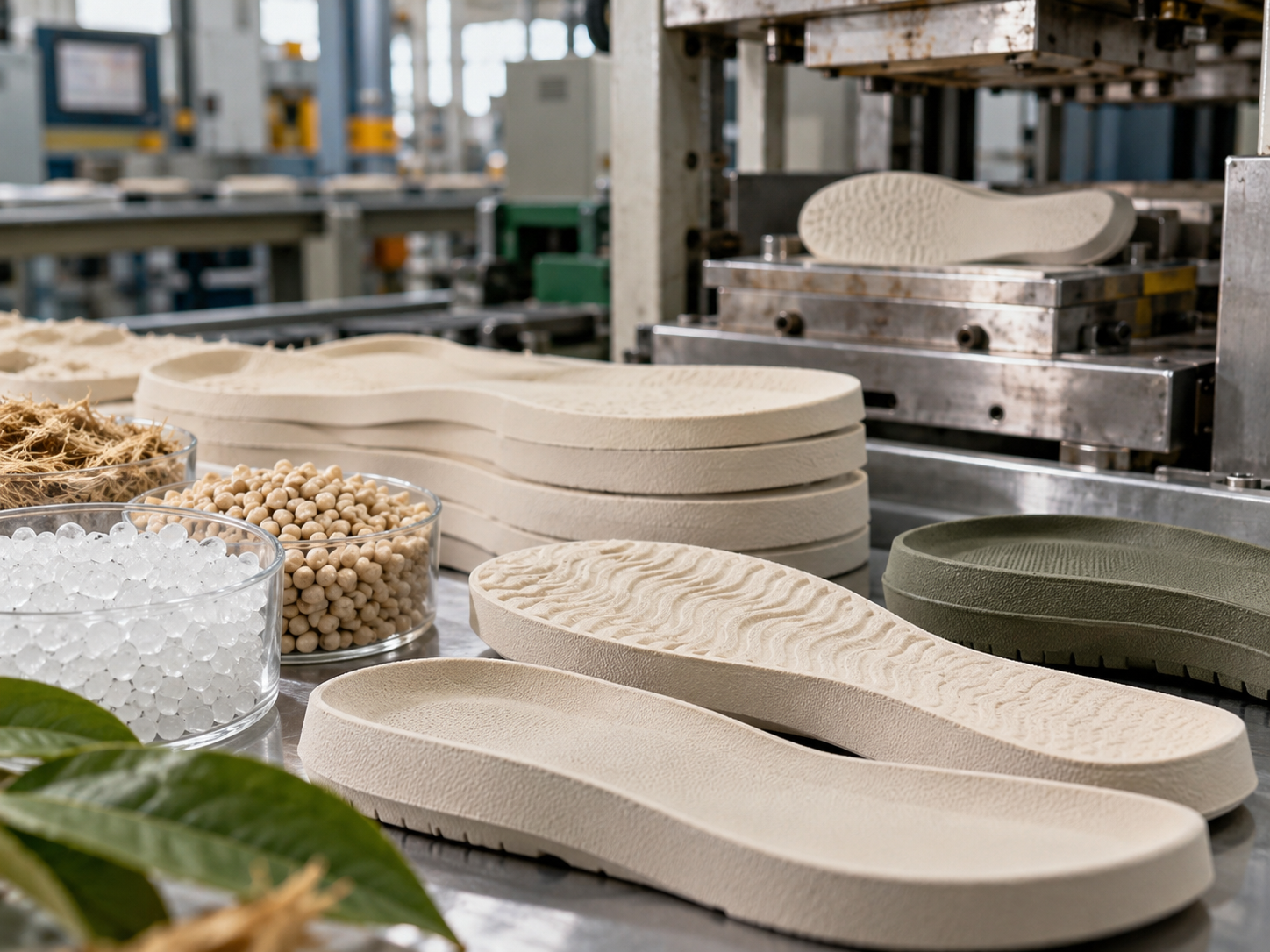
What Is BIO EVA, and How Can Plastic Come From Sugarcane?
BIO EVA, or Bio-Based Ethylene Vinyl Acetate, belongs to the same polymer family as conventional EVA. However, manufacturers replace some fossil-based raw materials with renewable biological resources, including sugarcane.
For decades, the footwear industry has relied on EVA because it offers lightweight construction, flexibility, cushioning, and shock absorption. These characteristics make EVA suitable for sandals, sports shoes, and other footwear applications.
Traditional EVA generally uses fossil-derived chemical feedstocks. In contrast, BIO EVA introduces renewable carbon into the production process while maintaining the polymer properties required for practical applications.
For example, Braskem, a global chemical producer, developed its I’m green™ bio-based EVA portfolio for several industries, including footwear. According to the company, certain grades contain approximately 45–80% bio-based carbon, depending on the formulation. Manufacturers can determine this percentage through standards such as ASTM D6866.
These developments demonstrate that manufacturers can reduce their reliance on fossil-derived carbon without completely redesigning existing polymer technologies.
Nevertheless, the bio-based carbon content of a raw material does not automatically represent the renewable content of an entire finished shoe.

From Sugarcane Fields to Sandals: How Is BIO EVA Made?
One of the most fascinating aspects of BIO EVA is its transformation from an agricultural resource into a modern industrial polymer.
The process connects farming, biotechnology, chemical engineering, and footwear manufacturing.
1. Sugarcane: A Renewable Starting Point
The journey begins with sugarcane, a crop that farmers can cultivate repeatedly.
During photosynthesis, sugarcane absorbs atmospheric carbon dioxide and converts it into organic compounds. These compounds provide the biological carbon used in subsequent manufacturing processes.
However, carbon absorption during plant growth does not automatically make sugarcane-based products carbon-neutral. Agricultural machinery, fertilizers, transportation, and industrial processing can still generate greenhouse gas emissions.
2. Bio-Ethanol: Converting Sugar Into Alcohol
Manufacturers extract fermentable sugars from sugarcane and use microorganisms to convert them into bio-ethanol.
Although many people associate ethanol with biofuels, the chemical industry can also use it as an important building block for advanced materials.
This process creates a connection between renewable agriculture and industrial polymer production.
3. Bio-Ethylene: Creating a Plastic Building Block
Next, manufacturers convert bio-ethanol into bio-ethylene through a chemical dehydration process.
Bio-ethylene has the same molecular structure as ethylene produced from fossil resources. Therefore, manufacturers can use it in established polymer production processes.
This chemical similarity represents a major advantage. Companies can change the origin of the carbon feedstock without necessarily changing the fundamental chemistry of the final polymer.
4. Bio-Based EVA: Producing the Polymer
Manufacturers combine ethylene with vinyl acetate through copolymerization to create EVA.
When ethylene originates from sugarcane, the resulting polymer contains renewable carbon.
However, vinyl acetate and other ingredients may still originate from fossil-based resources. Therefore, the actual bio-based content varies between products and manufacturers.
5. BIO EVA Foam: Creating Footwear Materials
Finally, manufacturers process EVA into foam using specialized formulations and molding techniques.
They can adjust density, flexibility, cushioning, and durability according to the intended application.
The resulting foam can become a component of sandals, casual footwear, athletic shoes, and other products.
From an agricultural field to a finished sole, this process demonstrates how renewable resources can enter the modern footwear industry.
Conventional EVA vs. BIO EVA: What Is the Difference?
The most significant difference between conventional EVA and BIO EVA lies in the origin of their raw materials.
Traditional EVA primarily relies on fossil-derived ingredients. Meanwhile, BIO EVA replaces some of these ingredients with renewable biological resources.
In terms of performance, manufacturers can formulate both materials to provide similar levels of flexibility, cushioning, softness, and lightweight comfort.
However, BIO EVA does not automatically outperform every conventional EVA product.
Actual performance depends on the polymer formulation, foam density, processing conditions, and footwear design.
Therefore, consumers and manufacturers should evaluate both environmental characteristics and practical functionality.
A responsible material choice should consider renewable content, durability, comfort, and verified environmental performance.


Three Reasons Why BIO EVA Matters for Sustainability
1. Reducing Dependence on Fossil Resources
One of BIO EVA’s most important advantages is its ability to replace some petroleum-derived ingredients with renewable feedstocks.
Petroleum and natural gas take millions of years to form. In comparison, crops such as sugarcane can grow within agricultural cycles.
By using renewable carbon sources, manufacturers can explore ways to reduce dependence on finite fossil resources.
This transition may also help diversify industrial supply chains over time.
However, responsible agricultural practices remain essential because renewable resources can still create environmental pressures.
2. Potentially Lowering Carbon Footprints
Certain BIO EVA formulations may offer lower greenhouse gas emissions than comparable fossil-based alternatives.
However, manufacturers must support such claims with reliable evidence.
Life Cycle Assessment, commonly called LCA, provides a systematic method for examining environmental impacts throughout a product’s life cycle or within a clearly defined assessment boundary.
An LCA may examine agricultural production, raw material processing, manufacturing, transportation, product use, and end-of-life management.
The results depend on factors such as energy sources, land-use practices, production efficiency, and the materials included in the assessment.
Consequently, a bio-based material does not automatically guarantee a lower carbon footprint in every application.
3. Supporting Circular Economy Innovation
BIO EVA can contribute to circular economy strategies when manufacturers combine renewable feedstocks with responsible product design and material management.
However, renewable sourcing alone does not create a circular product.
Manufacturers also need to reduce production waste, improve material efficiency, extend product life, and develop suitable recycling systems.
Researchers have explored methods for reusing EVA waste from footwear manufacturing. These studies demonstrate potential opportunities, although recycled materials may require additional processing and can exhibit different mechanical properties.
Circularity therefore depends on the complete production and consumption system, not simply the origin of a material.
The Hidden Truth: BIO EVA Is Not Automatically Biodegradable
This distinction is essential for understanding bio-based plastics.
The term bio-based describes materials made entirely or partly from biological resources.
Meanwhile, biodegradable refers to materials that microorganisms can break down under specific environmental conditions.
These terms describe different characteristics.
According to European Bioplastics and the European Commission, plastics derived from biological resources are not necessarily biodegradable.
Conventional bio-based EVA generally retains the polymer structure associated with fossil-based EVA. As a result, consumers should not assume that BIO EVA sandals will naturally decompose in soil or seawater.
Furthermore, some EVA foams use cross-linked polymer structures to improve performance. These structures can make conventional melt recycling more challenging.
None of these limitations eliminate the potential advantages of BIO EVA.
Instead, they highlight an important lesson: replacing fossil-derived ingredients is only one part of improving the environmental performance of footwear.
Reducing waste, developing responsible disposal systems, and designing longer-lasting products remain equally important.

Why Sustainable Footwear Requires More Than Better Materials
A single pair of sandals contains several components, including soles, straps, adhesives, decorative details, and packaging.
Even when a manufacturer replaces part of the sole with BIO EVA, other components may still come from fossil resources.
Moreover, a product with renewable materials may still generate substantial environmental impacts if consumers must replace it frequently.
That is why sustainable footwear development must consider three interconnected priorities: responsible material sourcing, product durability, and end-of-life management.
Comfortable and well-designed sandals can encourage longer use when their construction suits the wearer’s needs.
Similarly, efficient manufacturing processes can reduce waste before products ever reach consumers.
The question should therefore extend beyond whether a product contains environmentally preferable materials.
Manufacturers should also ask how long a product will last, how it performs, and whether they can verify its environmental claims.
Sandals World and SW GREEN: Where Material Innovation Meets Thai Craftsmanship
At Sandals World, the vision of Sustainable Thai Craft Sandals extends beyond the materials used in a finished product.
Our approach connects contemporary design, traditional craftsmanship, local communities, and a commitment to exploring more responsible production methods.
We believe meaningful footwear should combine beauty, comfort, and the human creativity behind every design.
Handmade Craft: Preserving the Value of Human Creativity
Sandals World celebrates handmade sandals created by Thai artisans and independent brands.
From macramé knotting and crochet techniques to designs inspired by local patterns and cultural traditions, each product reflects different forms of craftsmanship.
Artistic Handmade Sandals offer more than visual appeal. They provide a platform for artisans to express creativity, preserve practical skills, and introduce traditional techniques to contemporary audiences.
By supporting handmade products, consumers can also recognize the stories, knowledge, and communities behind their purchases.
This relationship between people and products represents an important part of the Sandals World identity.
SW GREEN: Exploring More Responsible Footwear Materials
SW GREEN represents Sandals World’s direction toward footwear material innovation, particularly the exploration of BIO EVA and natural rubber.
BIO EVA creates opportunities to reduce dependence on fossil-derived raw materials. Meanwhile, natural rubber provides another biological resource that manufacturers can develop for specific footwear applications.
However, neither material is automatically free from environmental impacts.
Responsible development requires careful evaluation of raw material origins, manufacturing processes, product performance, and supporting evidence.
By combining material innovation with craftsmanship, Sandals World aims to explore new possibilities for Thailand sandals while maintaining their distinctive cultural identity.
Art & Craft Sandals: Connecting Tradition With Innovation
The future of Art & Craft Sandals does not depend on aesthetics alone.
It also involves asking thoughtful questions about product materials, resource efficiency, and the methods used to manufacture each pair.
Technologies such as BIO EVA can complement traditional craftsmanship because they contribute different forms of value.
Material science helps manufacturers develop functional components. Handmade techniques provide creativity, artistic expression, and cultural identity.
Together, these approaches can inspire footwear that responds to modern consumer expectations without abandoning the skills and stories of local artisans.
Art & Craft Sandals: Connecting Tradition With Innovation
The future of Art & Craft Sandals does not depend on aesthetics alone.
It also involves asking thoughtful questions about product materials, resource efficiency, and the methods used to manufacture each pair.
Technologies such as BIO EVA can complement traditional craftsmanship because they contribute different forms of value.
Material science helps manufacturers develop functional components. Handmade techniques provide creativity, artistic expression, and cultural identity.
Together, these approaches can inspire footwear that responds to modern consumer expectations without abandoning the skills and stories of local artisans.
What Should Consumers Know Before Buying BIO EVA Sandals?
Although BIO EVA may sound environmentally friendly, consumers should evaluate specific product claims carefully.
First, they should consider the actual renewable content.
A raw material containing 80% bio-based carbon does not mean that an entire finished sandal consists of 80% plant-derived materials.
Other components, including straps, adhesives, and decorative elements, can significantly influence the composition of the final product.
Second, consumers should evaluate performance and durability.
Renewable material content alone cannot determine whether sandals provide adequate comfort, support, or longevity.
Finally, credible environmental claims should include supporting evidence.
Useful information may include bio-based carbon testing, material certifications, and life cycle assessment results with clearly defined boundaries.
Informed purchasing decisions can encourage brands to communicate sustainability more transparently rather than relying on broad environmental promises.
The Future of Footwear Will Require More Than Sugarcane
BIO EVA demonstrates that manufacturers can replace some fossil-derived raw materials with renewable alternatives while maintaining useful polymer characteristics.
However, transforming the footwear industry requires more than changing one ingredient.
Meaningful progress also depends on responsible design, efficient manufacturing, durable products, waste reduction, and verifiable environmental information.
For Sandals World, these considerations are closely connected to the direction of SW GREEN and our commitment to handmade craftsmanship and Thai communities.
We believe the future of Sustainable Thai Craft Sandals should celebrate creative expression while encouraging more responsible material choices.
BIO EVA may not solve the global plastic waste crisis, but it creates an important opportunity to rethink where our materials come from and how we use them.
Perhaps the future of sustainable footwear will not begin inside a shoe factory alone.
It may begin in a sugarcane field, continue through material innovation, and finally take shape in the hands of a Thai artisan.
That is the future Sandals World hopes to help create.
References and Further Reading
- Braskem — I’m green™ Bio-Based EVA
- European Bioplastics — What Are Bioplastics?
- European Commission — Bio-Based, Biodegradable and Compostable Plastics
Environmental considerations and guidance for biological plastic materials. - Springer Nature — Mechanical Characterization and Sustainability Assessment of Recycled EVA for Footwears (2023)
Research examining recycled EVA materials in footwear applications. - ACS Sustainable Chemistry & Engineering — Fabrication of Sustainable Composite Foam from EVA-Based Sole Waste (2023)
𝙎𝙖𝙣𝙙𝙖𝙡𝙨 𝙒𝙤𝙧𝙡𝙙 𝙞𝙨 𝙏𝙝𝙖𝙞𝙡𝙖𝙣𝙙’𝙨 𝙡𝙖𝙧𝙜𝙚𝙨𝙩 𝙝𝙪𝙗 𝙤𝙛 𝙖𝙧𝙩𝙞𝙨𝙩𝙞𝙘 𝙝𝙖𝙣𝙙𝙢𝙖𝙙𝙚 𝙨𝙖𝙣𝙙𝙖𝙡𝙨


ABOUT THE CONTENT CREATOR
BUNTHARIK INSIRI
(Content Writer)
Sandals World | Art & Craft Sandals | Sustainable Thai Craft Sandals Tags: handmade sandals, sandals world, foot health,
Thailand sandals, artistic handmade sandals, art & craft sandals, plantar fasciitis, bunion, sustainable sandals and BIO EVA ,SW GREEN

What Is BIO EVA? Can Sugarcane Plastic Save the Planet?
Post Views: 1 Every time we buy a new pair of sandals, we may unknowingly [...]
Oct

Are Your Sandals Harming the Planet Before You Even Wear Them? The BIO EVA Revolution
Post Views: 13 What if your favorite pair of sandals had already left an environmental [...]
Oct

The Ocean Is Heating Faster Than Ever: Why Low-Carbon Design Must Start Now
Post Views: 9 What if the ocean we know today no longer looks the same [...]
Oct

If Local Art Disappears, What Will the World Remember? From Mae Hong Son to D NICE MARKET with Sandals World
Post Views: 19 Imagine a future where traditional patterns disappear from local communities. Craft techniques [...]
Oct

VPADA Handmade Sandals: Where Thai Craft Blooms Into Modern Style
Post Views: 11 “Walk with nature, step with grace.” What if a small woven flower, [...]
Oct

Plastic Waste and Sustainable Sandals: Better Materials, Better Truth, Better Steps
Post Views: 21 Plastic has transformed modern life. Its lightweight structure, versatility, and low cost [...]
Oct

What’s Really Under Your Feet? From Plastic and EVA Foam to BIO EVA SW GREEN
Post Views: 21 Plastic is everywhere. We drink from it, carry food in it, build [...]
Sep

Only 9% Gets Recycled: Are We Solving the Plastic Crisis the Wrong Way?
Post Views: 19 Every time we drop a plastic bottle into a recycling bin, we [...]
Sep
SANDALS WORLD GUIDE




Artistic Handmade Sandals
BY
SANDALS WORLD THAILAND
The Largest Hub
of Artistic Handmade Sandals in Thailand.