

Brand Stories
6,000 Tons of Industrial Waste in Thailand: Real Recycling or Just Dumping the Problem on Someone Else?
Nov
6,000 Tons of Industrial Waste in Thailand: Real Recycling or Just Dumping the Problem on Someone Else?
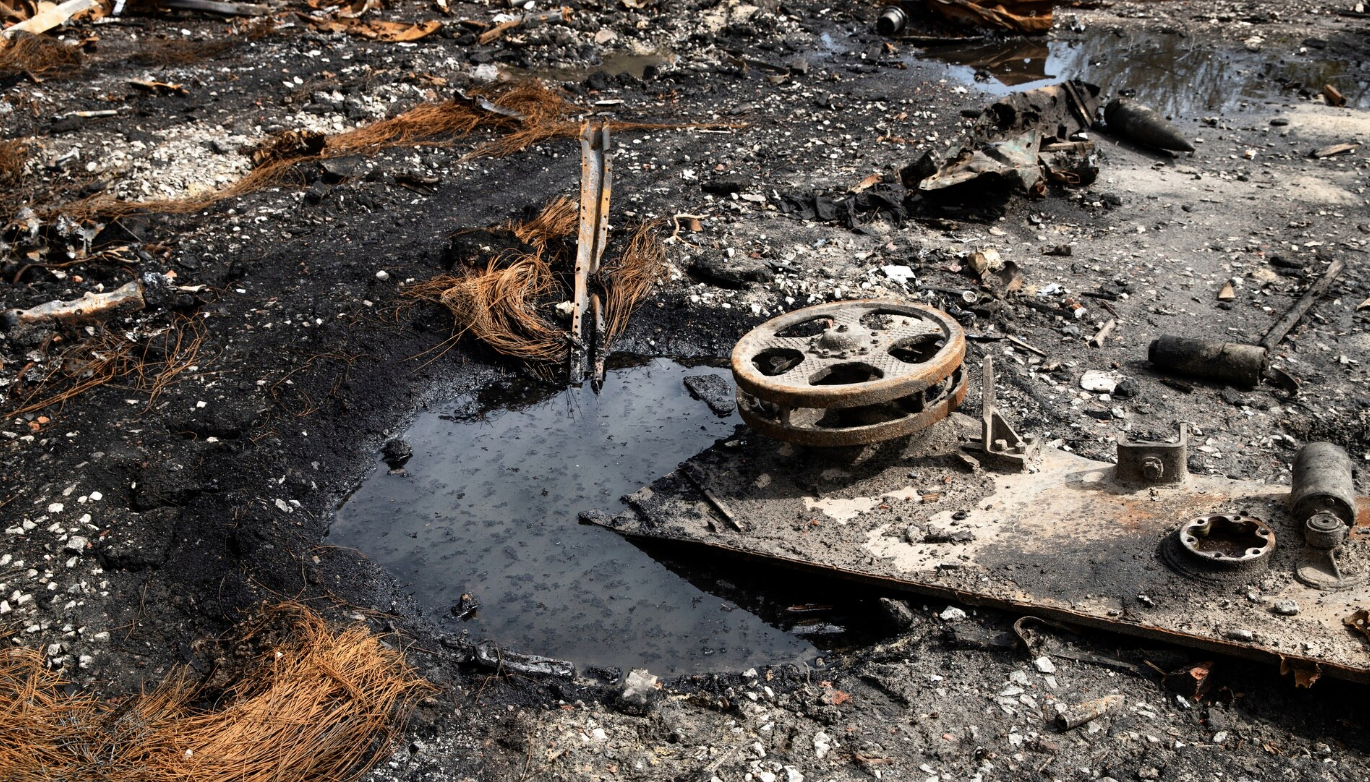
The waste we throw away doesn’t simply disappear. Sometimes, where it ends up is more disturbing than we imagine.
Picture a massive pile of industrial waste. Shredded electrical cables, crushed plastics, old electronic components, and scrap materials are stacked inside enormous warehouses. No one seems to know exactly where all this waste is supposed to go next.
Sounds like a scene from a post-apocalyptic movie, right?
Unfortunately, this isn’t fiction. It’s happening in Thailand.
Between November 18 and 19, 2026, Thai authorities uncovered more than 6,000 tons of industrial waste in Chachoengsao Province. The discovery raised serious environmental concerns, particularly after preliminary inspections detected several potentially hazardous substances in waste samples.
Suddenly, the word recycling, something we’ve always associated with protecting the planet, started to feel a little more complicated.
If we send our waste away for recycling, only for some of it to end up being illegally dumped, how much good are we actually doing for the environment?
And perhaps the bigger question is: Who should be held responsible?
6,000 Tons of Industrial Waste in Thailand: What Actually Happened?
On November 17, 2026, police in Saraburi Province intercepted trucks linked to the suspected illegal dumping of industrial waste in Phu Khae Subdistrict, Chaloem Phra Kiat District.
The investigation led authorities to a waste storage facility in neighboring Chachoengsao Province.
The following day, officials from several government agencies inspected a site operated by KOK Recycle & Services Co., Ltd. in Plaeng Yao District.
What they discovered was staggering.
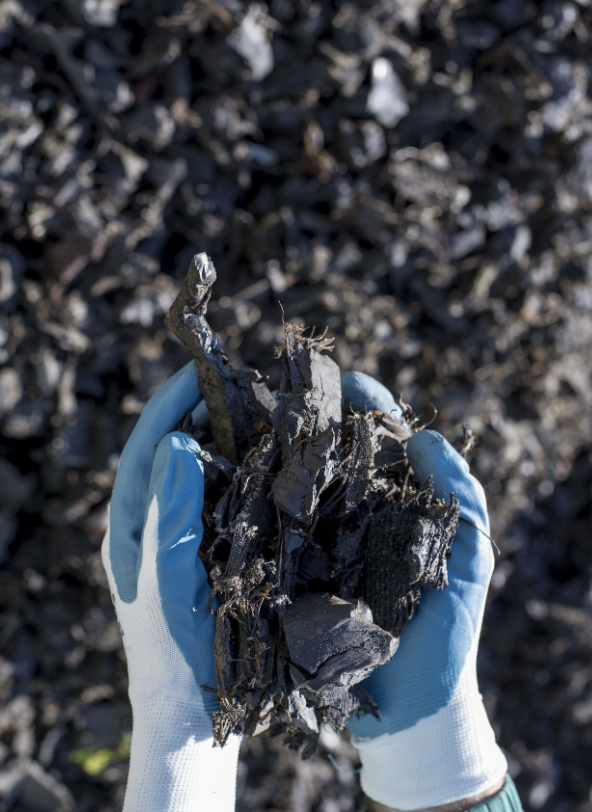
More than 6,000 tons of industrial waste and electronic waste were stored inside and around three warehouses. The materials included electrical wiring, shredded cable insulation, scrap metals, and discarded electronic components.
Thailand’s Pollution Control Department conducted preliminary screenings using X-ray fluorescence (XRF) technology.
The tests detected six elements of concern: arsenic, cadmium, lead, mercury, nickel, and antimony.
However, an important distinction needs to be made.
The reported 6,000 tons refers to the amount of waste found at the inspected site. It does not mean authorities have confirmed that all of it was illegally dumped.
Investigators are still examining transportation records, the involvement of relevant operators, and additional laboratory results.
More details are available in Thai PBS’s report on the industrial waste warehouse investigation in Chachoengsao.
Although the investigation remains ongoing, the case reveals something important: industrial waste management is far more complicated than simply collecting unwanted materials and sending them away.
Toxic Waste Is Closer to Everyday Life Than You Think
Industrial waste might sound like a problem that belongs entirely to large factories.
But take a look around.
Your old smartphone, broken laptop, damaged charging cable, or outdated household appliances could eventually become electronic waste.
The same applies to countless products we use every day.
Behind the scenes, manufacturing industries also produce leftover materials, chemical residues, and different categories of waste. Each requires its own handling and disposal methods.
Of course, not all industrial waste is hazardous.
However, certain materials may contain toxic substances and cannot be treated like ordinary household rubbish.
Why Are Heavy Metals So Dangerous?
Some heavy metals can pose serious health risks, particularly when people are exposed to harmful amounts over time.
Lead, for example, can affect the nervous system and children’s development.
Certain forms of mercury may damage the nervous system and kidneys, while exposure to some forms of arsenic can increase the risk of long-term health problems.
According to the World Health Organization (WHO), exposure to these substances can occur through contaminated dust, air, water, or food, depending on the chemical and the route of exposure.
Still, detecting potentially hazardous elements in waste does not automatically mean nearby communities have been exposed.
A proper environmental assessment must consider the concentration of substances, their chemical forms, and whether contamination has spread into the surrounding environment.
The concern is what could happen if hazardous waste is stored, transported, or disposed of without appropriate safeguards.
In the worst-case scenario, surrounding communities may end up dealing with environmental damage they never helped create.
And that’s where the issue becomes much bigger than waste management alone.
Does Recycling Really Help the Planet, or Just Make Us Feel Better?
We’ve all seen the recycling symbol.
Three arrows forming a triangle. A familiar icon printed on packaging, plastic bottles, clothing tags, and countless everyday products.
For many of us, seeing the word recyclable feels reassuring.
It suggests that a product has a better chance of avoiding the landfill and becoming something useful again.
And to be fair, that idea isn’t wrong.
Proper recycling can recover valuable materials, reduce demand for virgin resources, and prevent certain types of waste from being sent directly to disposal facilities.
But here’s the catch.
Not everything can be recycled easily, economically, or safely.
Some materials require complicated sorting, washing, shredding, or chemical treatment.
Others contain hazardous substances that need special handling. Certain waste streams are also difficult to recycle because recovering their materials costs more than the materials themselves are worth.
That leaves us with another question.
What happens to the waste that remains after recycling?
A recycling facility might successfully recover metals or plastics from discarded products. Yet the remaining residues still need to be treated or disposed of responsibly.
Recycling doesn’t end when valuable materials have been extracted.
The waste left behind matters just as much.
Without proper oversight, the environmental benefits of recycling can be undermined by the way its remaining waste is managed.

The Hidden Destination of Waste Could Become Someone Else’s Problem
One of the biggest challenges in industrial waste management is cost.
Treating hazardous substances, transporting waste safely, and following environmental regulations all require investment.
Responsible operators include those costs in their business activities.
However, if certain companies attempt to avoid disposal expenses by illegally dumping waste, part of the financial burden may eventually be transferred to society.
Think about communities living near an unauthorized dumping site.
If contamination occurs, residents may have to worry about their drinking water, agricultural land, or family health.
They could face consequences from an industrial activity they never benefited from.
Of course, this doesn’t mean all recycling companies operate irresponsibly.
Many legitimate recycling businesses play an essential role in recovering resources and reducing the demand for new materials.
The real challenge is making sure the system can distinguish responsible operators from those who fail to follow environmental regulations.
This becomes especially important when industrial waste passes through several transportation and treatment companies before reaching its final destination.
Tracking waste from where it originates to where it is ultimately treated or disposed of is critical.
Because sending waste somewhere isn’t the same as managing it properly.


Circular Economy Is About More Than Recycling Everything
The term Circular Economy has become increasingly popular in conversations about sustainability.
Fashion brands promote recycled fabrics. Businesses introduce reusable packaging. Manufacturers experiment with production methods designed to reduce waste.
These developments can be positive.
But a circular economy is about much more than turning discarded materials into new products.
Its central idea is to reduce waste from the beginning, keep products and materials useful for as long as possible, and manage whatever remains responsibly.
For example, designing products that can be repaired may help extend their useful life.
Similarly, reusable packaging can reduce demand for new packaging materials in systems where collection, cleaning, and repeated use are effective.
This approach aligns with the United Nations Environment Programme’s Global Waste Management Outlook 2024, which emphasizes waste prevention alongside responsible materials management throughout the product life cycle.
In simple terms, recycling is one part of the solution.
It isn’t the entire solution.
The world doesn’t just need better ways to recycle waste.
It also needs better ways to avoid generating unnecessary waste in the first place.
How Is Thailand Addressing Illegal Industrial Waste Dumping?
Thailand is working to strengthen industrial waste monitoring and make waste transportation more traceable.
One proposed measure involves tracking industrial waste shipments through a real-time digital system.
The Department of Industrial Works previously announced plans to introduce GPS-based monitoring through an application, targeting January 1, 2027, for implementation.
The proposed system aims to connect information between waste-generating factories, transportation companies, and receiving facilities.
By improving visibility throughout the process, authorities hope to reduce opportunities for waste to be diverted to unauthorized locations.
Alongside this initiative, Thailand has been working on industrial waste management legislation and approaches based on the Polluter Pays Principle.
This principle holds that those responsible for pollution should bear the costs associated with managing its impacts.
Further information can be found through Thailand’s Department of Industrial Works.
Still, GPS technology alone won’t solve everything.
Reliable reporting, effective inspections, enforcement, and corporate transparency will remain essential.
As for the Chachoengsao case, several questions still need answers.
What will the final laboratory results reveal? How will the 6,000 tons of waste be safely managed? And what measures will prevent similar incidents in the future?
Those answers matter far beyond this single investigation.
What Does Industrial Waste Have to Do With Fashion?
At first glance, a pair of sandals might seem completely unrelated to thousands of tons of electronic waste.
But there’s one important connection.
Every product has a life cycle.
Clothing, bags, and sandals all begin with raw materials. They go through manufacturing and transportation before reaching customers. Eventually, they may become waste.
A single pair of sandals can contain EVA foam, natural rubber, textile fibers, adhesives, and decorative components.
These materials have different properties, and separating them after the product has been assembled can be difficult.
As a result, recycling an entire pair of sandals isn’t necessarily as straightforward as recycling a single type of material.
This issue is explored further in Sandals World’s article, Plastic Waste and Sustainable Sandals: Better Materials, Better Truth, Better Steps, which examines the environmental impacts of footwear from material selection to the end of its useful life.
Fast-changing fashion trends also raise questions about how often we replace products that are still perfectly usable.
Wearing an existing pair of sandals for longer, taking care of them properly, or repairing damaged parts where possible can help extend their useful life.
For the fashion industry, meaningful sustainability may not always begin with launching another collection labeled Green.
Sometimes, it begins with understanding the environmental impacts of the products we already make.
BIO EVA SW GREEN
Sandals World and a New Conversation About Sustainability
For Sandals World, developing handmade sandals involves more than creating attractive designs or comfortable footwear.
It also connects craftsmanship, materials, and the communities behind each product.
Many Thai footwear brands are known for traditional techniques such as macramé knotting, handweaving, and handcrafted decorative details.
These skills give handmade products their distinctive character while helping preserve valuable craft traditions.
The concept of Artistic Handmade Sandals celebrates creative design and individual craftsmanship.
Meanwhile, Art & Craft Sandals create opportunities for traditional techniques to become part of contemporary fashion.
However, there’s an important point worth remembering.
Handmade doesn’t automatically mean environmentally friendly.
The materials used, manufacturing methods, product lifespan, and waste management practices all contribute to a product’s overall environmental impact.
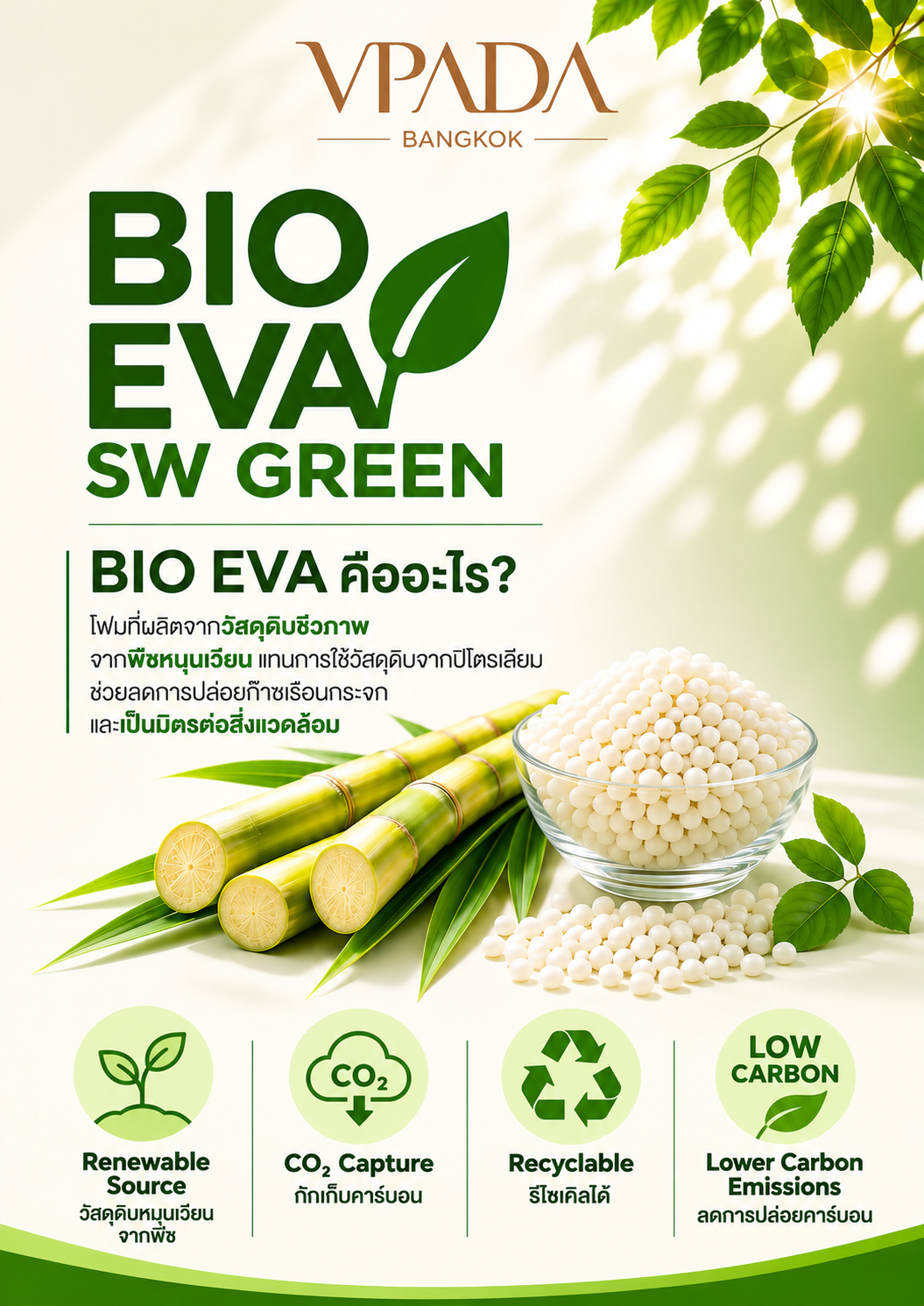
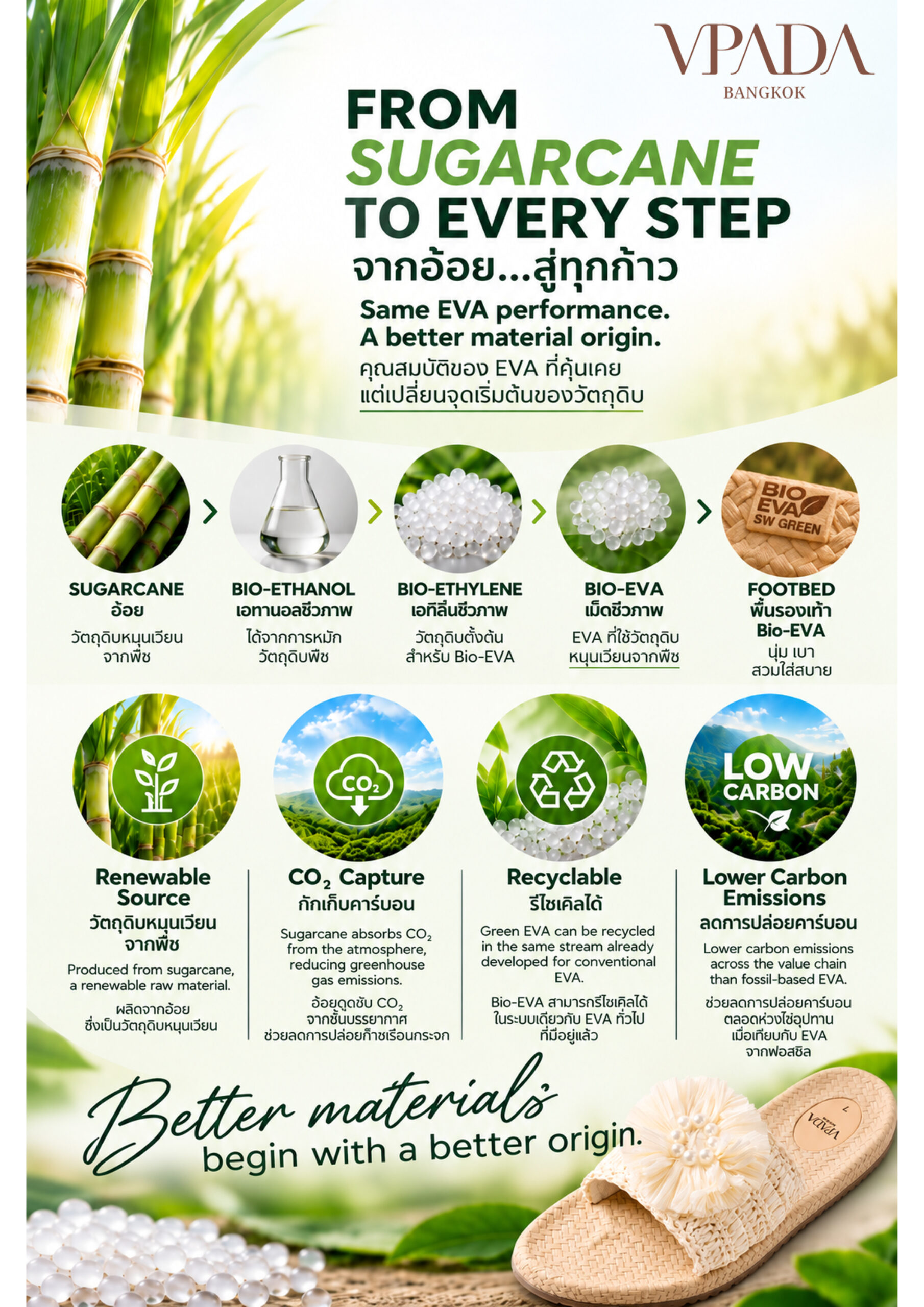
One material initiative being developed by Sandals World is BIO EVA SW GREEN.
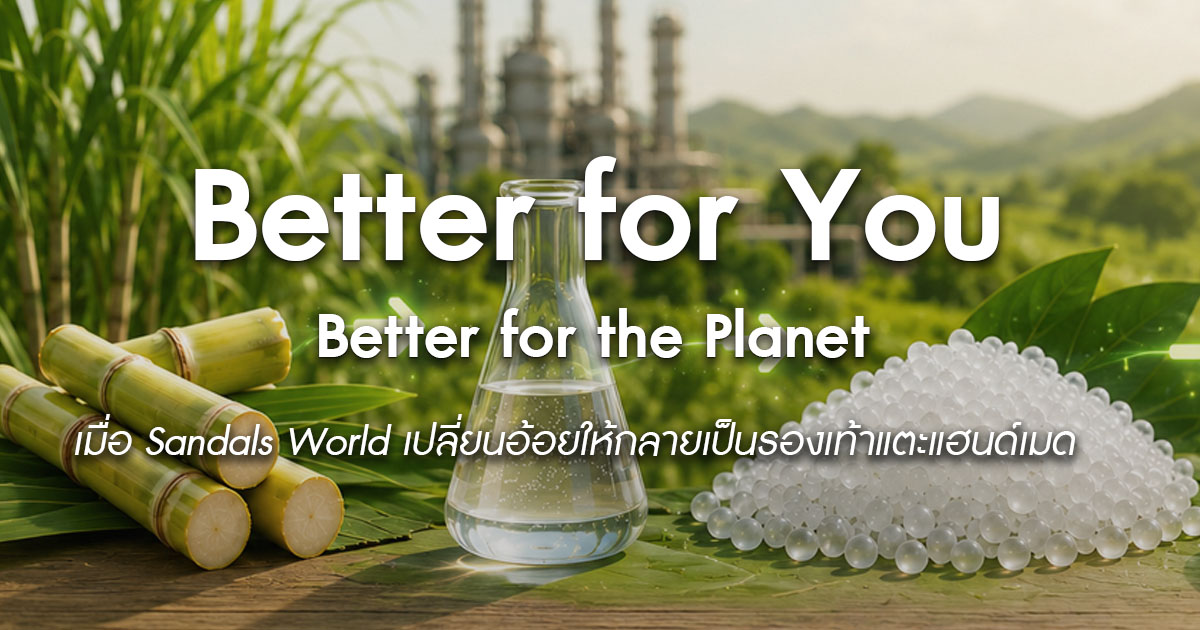
This approach uses sugarcane-derived raw materials to partially replace fossil-based feedstocks in the production of EVA foam.
Changing the origin of these raw materials offers an opportunity to reduce dependence on fossil resources.
However, it doesn’t mean that an entire pair of sandals becomes biodegradable or automatically recyclable.
The opportunities and limitations of this material transition are explained in BIO EVA: A Material Transition for Handmade Sandals.
Looking ahead, the future of Thailand sandals in international markets may involve more than competing through design and product quality alone.
Explaining material origins, supporting local artisans, and communicating environmental efforts transparently can also help build trust in Thai craftsmanship.
The goal of Sustainable Thai Craft Sandals should therefore be understood as an ongoing commitment to improvement.
Not a promise that every product has already achieved environmental perfection.
After all, sustainability is a journey of making more responsible decisions, understanding their limitations, and continuing to improve.

Want to Make a Difference? Start With What You Already Own
Reading about thousands of tons of hazardous industrial waste can make environmental problems feel overwhelming.
It’s easy to wonder whether individual choices really make any difference.
The reality is that consumers still have opportunities to reduce unnecessary resource use in everyday life.
Before buying something new, consider whether the item you already own is still usable.
Could a damaged product be repaired?
If you need a replacement, do you understand what materials it contains and how long it is likely to last?
Making thoughtful purchasing decisions doesn’t mean giving up fashion or personal style.
We can still enjoy dressing up, discovering new designs, and supporting creativity.
The difference is paying more attention to quality, usefulness, and how products fit into our lives.
For businesses, responsibility goes further than placing a recycling symbol on packaging.
It includes understanding raw material sources, working with properly authorized waste management companies, and verifying how manufacturing waste is actually handled.
At the same time, industrial waste pollution cannot be solved through consumer behavior alone.
Businesses and regulators must also fulfill their responsibilities.
Environmental progress requires action across the entire system, not just at the checkout counter.


Waste Doesn’t Disappear. We Just Stop Seeing It.
The discovery of more than 6,000 tons of industrial waste in Chachoengsao is more than another alarming news headline.
It draws attention to places most of us rarely think about.
Waste storage warehouses. Transportation routes. Industrial treatment facilities. Final disposal sites.
We often talk about sustainability through beautiful images of green forests, plant-based materials, and thoughtfully designed products.
But those images tell only part of the story.
The waste we don’t see matters, too.
Recycling remains an important environmental solution when it is carried out responsibly.
Yet we also need to ask harder questions about where waste goes and what happens after it leaves our hands.
Because responsible waste management shouldn’t end when rubbish disappears from sight.
It should end with confidence that the waste has been managed safely, without shifting its environmental and social costs onto someone else.
Perhaps that’s one of the most important meanings of sustainability.
Not simply creating products that appear greener, but taking responsibility for the environmental impacts we leave behind.
𝙎𝙖𝙣𝙙𝙖𝙡𝙨 𝙒𝙤𝙧𝙡𝙙 𝙞𝙨 𝙏𝙝𝙖𝙞𝙡𝙖𝙣𝙙’𝙨 𝙡𝙖𝙧𝙜𝙚𝙨𝙩 𝙝𝙪𝙗 𝙤𝙛 𝙖𝙧𝙩𝙞𝙨𝙩𝙞𝙘 𝙝𝙖𝙣𝙙𝙢𝙖𝙙𝙚 𝙨𝙖𝙣𝙙𝙖𝙡𝙨

ABOUT THE CONTENT CREATOR
BUNTHARIK INSIRI
(Content Writer)
Sandals World | Art & Craft Sandals | Sustainable Thai Craft Sandals Tags: handmade sandals, sandals world, foot health,
Thailand sandals, artistic handmade sandals, art & craft sandals, plantar fasciitis, bunion, sustainable sandals and BIO EVA ,SW GREEN
References and Further Reading
- Thai PBS — Investigation Into 6,000 Tons of Industrial Waste in Chachoengsao
- Department of Industrial Works, Thailand — Industrial Waste Management Initiatives
- UNEP — Global Waste Management Outlook 2024
- WHO — Lead Poisoning and Health
Editor’s Note: This article reflects information available as of November 20, 2026. Findings reported by authorities are distinguished from allegations that remain under investigation.
Brand Partner News Sustainability Knowledge & Insights Sandals World News Community Brand Stories Travel & Destinations Events
How Does Sugarcane End Up in Sandal Soles? Meet BIO EVA SW GREEN by Sandals World
Views: 0 Imagine holding two sandal soles. Someone tells you that one was made partly [...]
Nov
6,000 Tons of Industrial Waste in Thailand: Real Recycling or Just Dumping the Problem on Someone Else?
Views: 27 6,000 Tons of Industrial Waste in Thailand: Real Recycling or Just Dumping the [...]
Nov
From Sugarcane Fields to Sandals: Why Is Sugarcane Becoming a Key Material for Bio-Based EVA?
Views: 16 From Sugarcane Fields to Sandals: Why Is Sugarcane Becoming a Key Material for [...]
Nov

Thai Dress Adventure 2026: Explore Bangkok, Discover Thai Culture & Style Your Day with VPADA BANGKOK
Views: 19 VPADA BANGKOK Dress Thai, Walk VPADA! — Thai Charm in Every Step. Café [...]
Nov
Where Does Our Waste Really Go? And How Long Can We Keep Living This Way?
Views: 30 As environmental challenges become impossible to ignore, Sandals World is taking a small [...]
Nov
From Oil to Sugarcane: How Plastic Materials Are Changing the Future of Handmade Sandals
Views: 31 Fossil-Based Plastic vs. Bio-Based EVA: A New Material Choice for Handmade Sandals Have [...]
Nov

Milala Handmade at POPUPASIA 2026: Every Knot Tells a Story, Every Connection Matters
Views: 50 More Than Sandals. A Story of Craftsmanship, Love, and the People Who Make [...]
Nov

Thailand Tourism 2026: Fewer Tourists, But Is Thailand Entering a New Era of Travel?
Views: 34 Fewer international visitors, changing spending patterns, and a growing focus on meaningful experiences. [...]
Nov
SANDALS WORLD GUIDE
Artistic Handmade Sandals
BY
SANDALS WORLD THAILAND
The Largest Hub
of Artistic Handmade Sandals in Thailand.