

Nov
From Sugarcane Fields to Sandals: Why Is Sugarcane Becoming a Key Material for Bio-Based EVA?
What does sugarcane have to do with the sandals on your feet?
Probably more than you think.
That soft, lightweight foam we love in our everyday sandals has a story that goes far beyond comfort. And surprisingly, part of that story could begin in a sugarcane field.
Most of us know sugarcane as the plant behind sugar, sweet drinks, and plenty of familiar treats. But today, it’s also playing a role in something completely different: the development of alternative materials for the fashion and footwear industries.
One of those innovations is BIO EVA, a material that can replace some petroleum-based ingredients traditionally used to make EVA foam.
Sounds like a pretty good idea, right?
But here’s the interesting question: Why sugarcane?
With so many plants available, including corn, cassava, and sugar beet, what makes sugarcane such a promising option?
The answer goes beyond sustainability. It involves chemistry, energy efficiency, industrial technology, and a different way of thinking about the materials we use every day.
And once you understand the science behind it, you might never look at your sandals quite the same way again.
Are Your Everyday Sandals Really Made from Petroleum?
Before we get into sugarcane, let’s talk about something a little closer to home: the soles of our shoes.
Many sandals use a material called EVA, short for Ethylene-Vinyl Acetate.
It’s lightweight, flexible, soft, and great at absorbing impact. These qualities explain why EVA is so widely used in footwear, from everyday sandals to athletic shoes.
There’s just one detail most people don’t think about.
The ethylene used in conventional EVA is typically derived from fossil-based feedstocks.
In other words, part of the comfort we enjoy every day begins with resources that took millions of years to form underground.
Petroleum-based materials have helped shape the modern footwear industry. They’re versatile, widely available, and suitable for large-scale production.
Still, that doesn’t mean we have to depend on the same raw materials forever.
Advances in chemistry now make it possible to produce ethylene using renewable biological resources.
And that’s exactly where sugarcane enters the picture.
From Sugarcane to BIO EVA: How Does a Plant Become Foam?
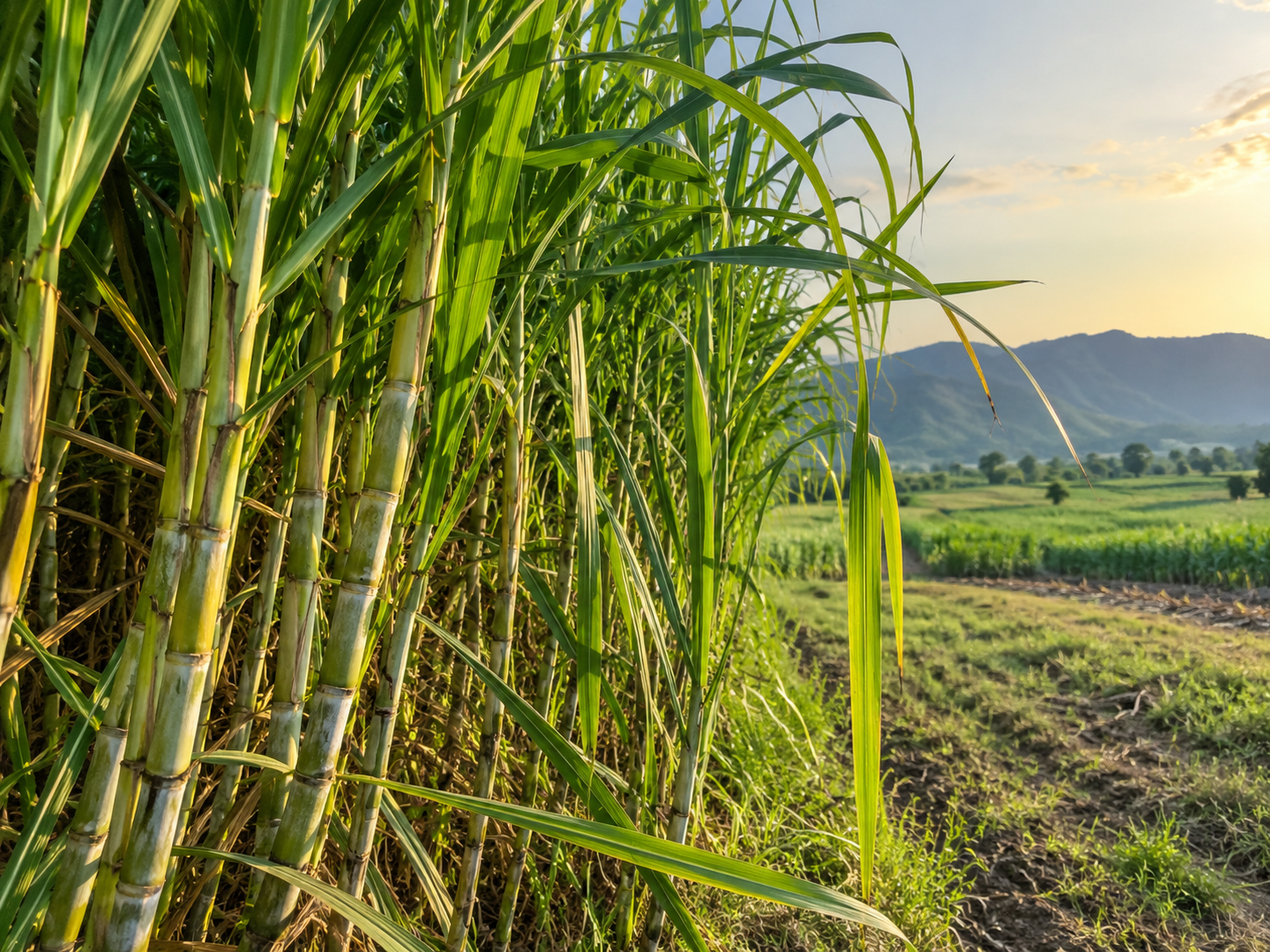
Picture a sugarcane field stretching toward the horizon.
Those tall green stalks are packed with sugars produced through photosynthesis. Using sunlight, water, and carbon dioxide, the plants create and store energy as they grow.
That natural process gives us something valuable: sugars that can become a starting point for industrial materials.
The journey begins by extracting sugar from sugarcane.
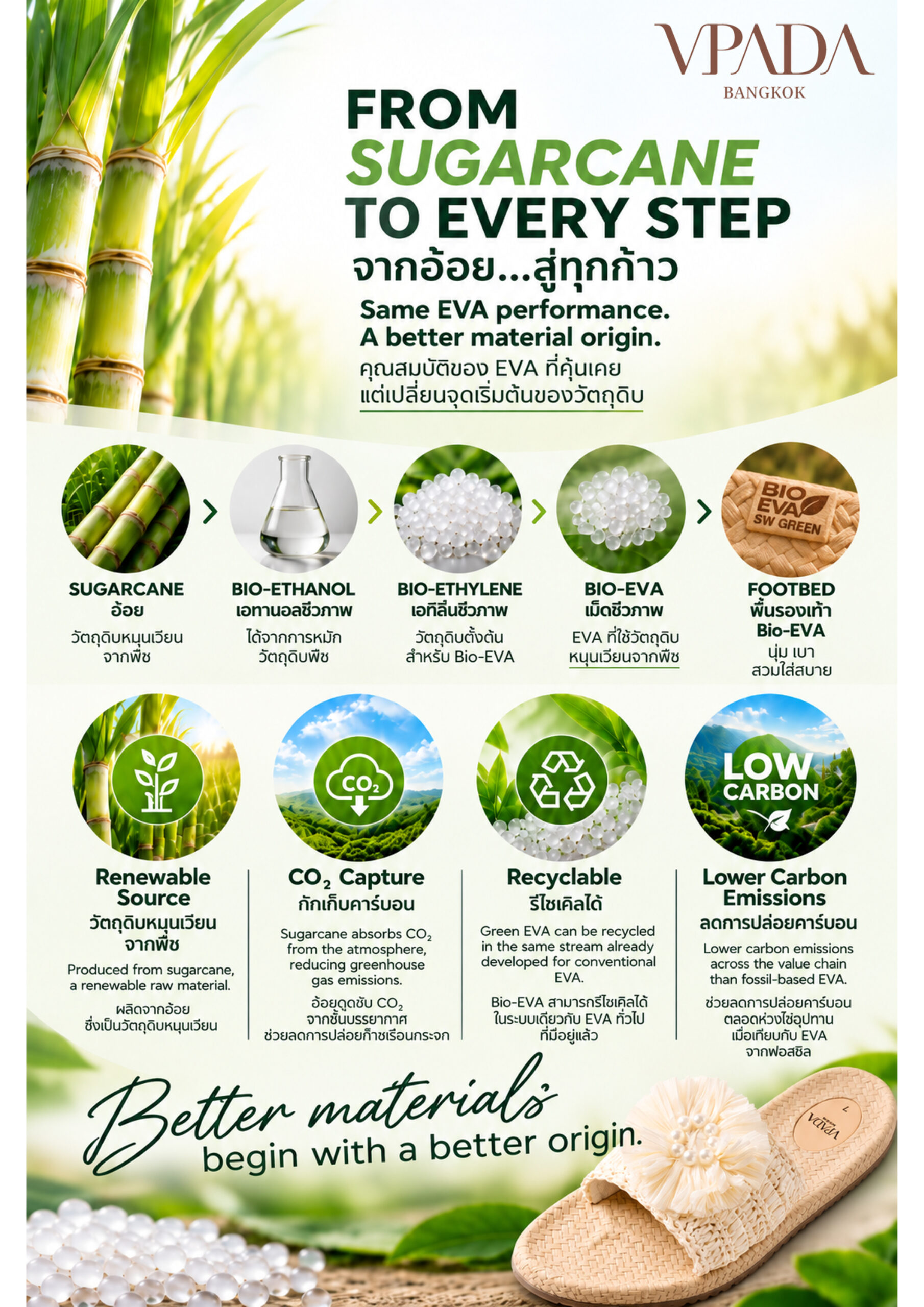
Next, microorganisms ferment the sugars to produce bioethanol. Through a chemical process called dehydration, that bioethanol can then be converted into bioethylene.
Manufacturers can use bioethylene to produce Bio-based EVA, which can eventually be processed into foam for footwear.
The Journey from Sugarcane to Sandals
Sugarcane → Bioethanol → Bioethylene → Bio-Based EVA → Foam Sole
The interesting part?
The finished sandals don’t necessarily have to look or feel different.
Instead, the innovation happens much earlier, at the raw-material stage.
It’s worth pointing out that Bio-based EVA isn’t made entirely from sugarcane. EVA also contains vinyl acetate, and the biological content depends on the specific material grade.
So this isn’t about turning plastic into a completely natural material.
It’s about replacing part of the fossil-based feedstock with a renewable alternative.
A small change at the beginning of the production chain could open the door to a different approach to footwear materials.
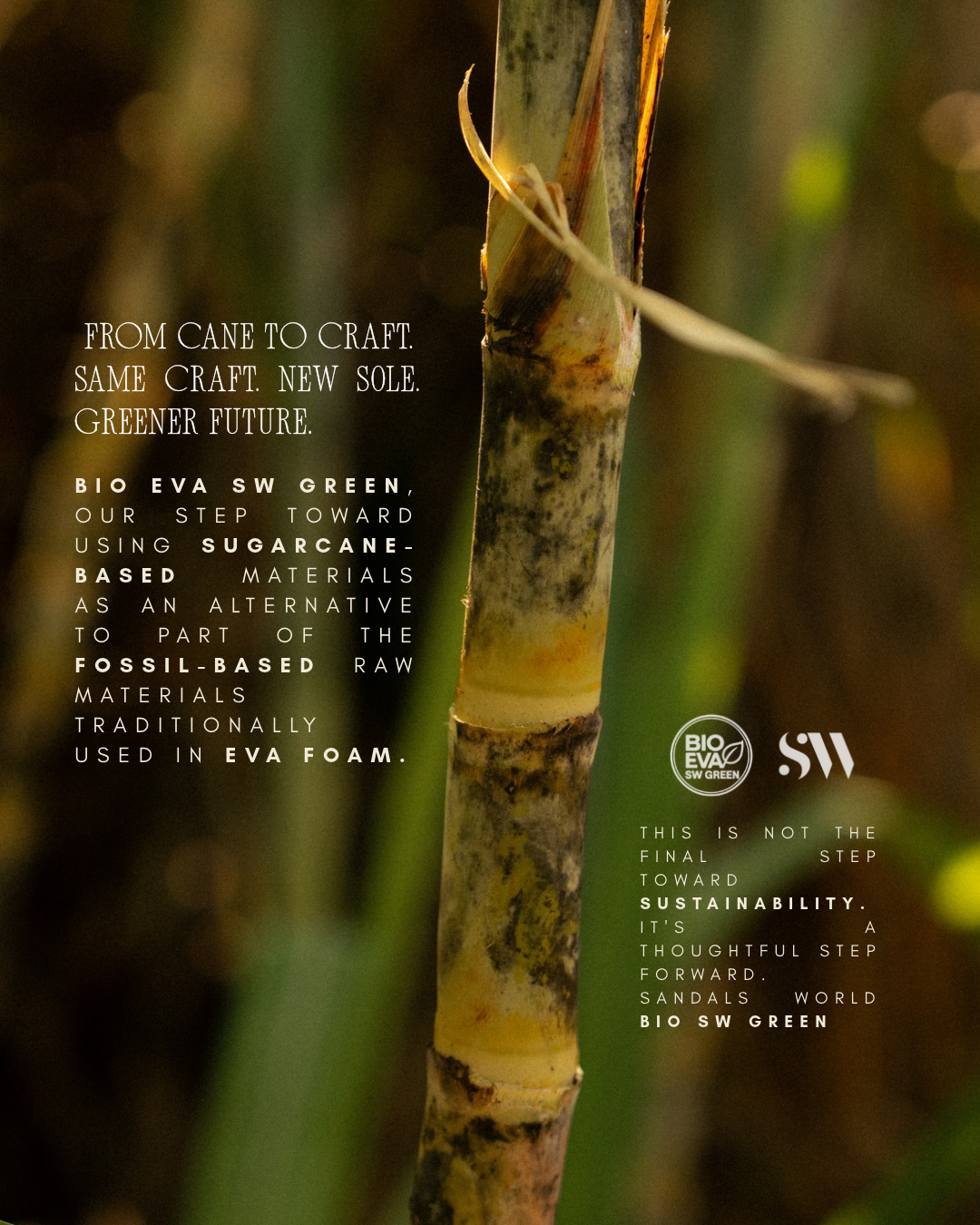
Why Sugarcane? What Makes It Different from Other Plants?
Sugarcane isn’t the only crop that can produce bioethanol.
Corn, cassava, and sugar beet can also serve as feedstocks for bio-based materials.
However, sugarcane offers several advantages that make it particularly interesting for industrial applications.
1. Sugarcane Already Contains Fermentable Sugar
Here’s a simple but important difference.
Sugarcane stores much of its energy as sucrose, a sugar that can be extracted and fermented into ethanol.
Corn and cassava, on the other hand, mainly store carbohydrates as starch.
Before manufacturers can ferment those starches, they need to break them down into sugars.
That extra processing can require additional enzymes, energy, and equipment.
Sugarcane therefore has an advantage when it comes to preparing the feedstock for ethanol production.
Of course, this doesn’t automatically mean sugarcane always requires less energy overall.
The efficiency of each production system still depends on the technology, energy sources, agricultural practices, and factory operations involved.
But in an industry where even small improvements can matter at scale, a simpler processing pathway is certainly worth exploring.
2. Sugarcane Waste Can Become a Source of Energy
Here’s something that makes sugarcane even more interesting.
After sugarcane is crushed to extract its juice, a fibrous material called bagasse remains.
Rather than treating it entirely as waste, sugar mills can use bagasse as fuel to generate heat, steam, and electricity.
Think about that for a second.
A facility can use sugarcane to produce ethanol while also using its leftover fibers to supply energy for part of the manufacturing process.
This integrated system can reduce dependence on external energy sources, including fossil fuels.
According to the OECD-FAO Agricultural Outlook 2025–2034, sugarcane and its by-products play an important role in the bioenergy sectors of countries such as Brazil, India, and Thailand.
That gives sugarcane an advantage beyond its sugar content.
It’s not just a crop that provides a raw ingredient. Under the right conditions, it can also support the energy needs of the production system.
3. The Technology Is Already Being Used Commercially
A sustainable idea sounds great on paper.
But can it actually work at an industrial scale?
That’s where sugarcane has another important advantage.
Countries such as Brazil have spent decades developing sugarcane-based ethanol industries, building expertise in cultivation, fermentation, processing, and distribution.
This existing infrastructure makes sugarcane an established feedstock for industrial bioethanol production.
Materials company Braskem has also developed its I’m green™ Bio-based EVA portfolio using bioethylene derived from sugarcane ethanol.
These materials can be used in applications including footwear.
That means sugarcane-based EVA isn’t simply a futuristic concept or an experiment confined to a research laboratory.
Commercial production already exists.
However, production costs and environmental performance can still vary significantly between countries and facilities.
The availability of technology is an advantage, but how that technology is implemented matters just as much.
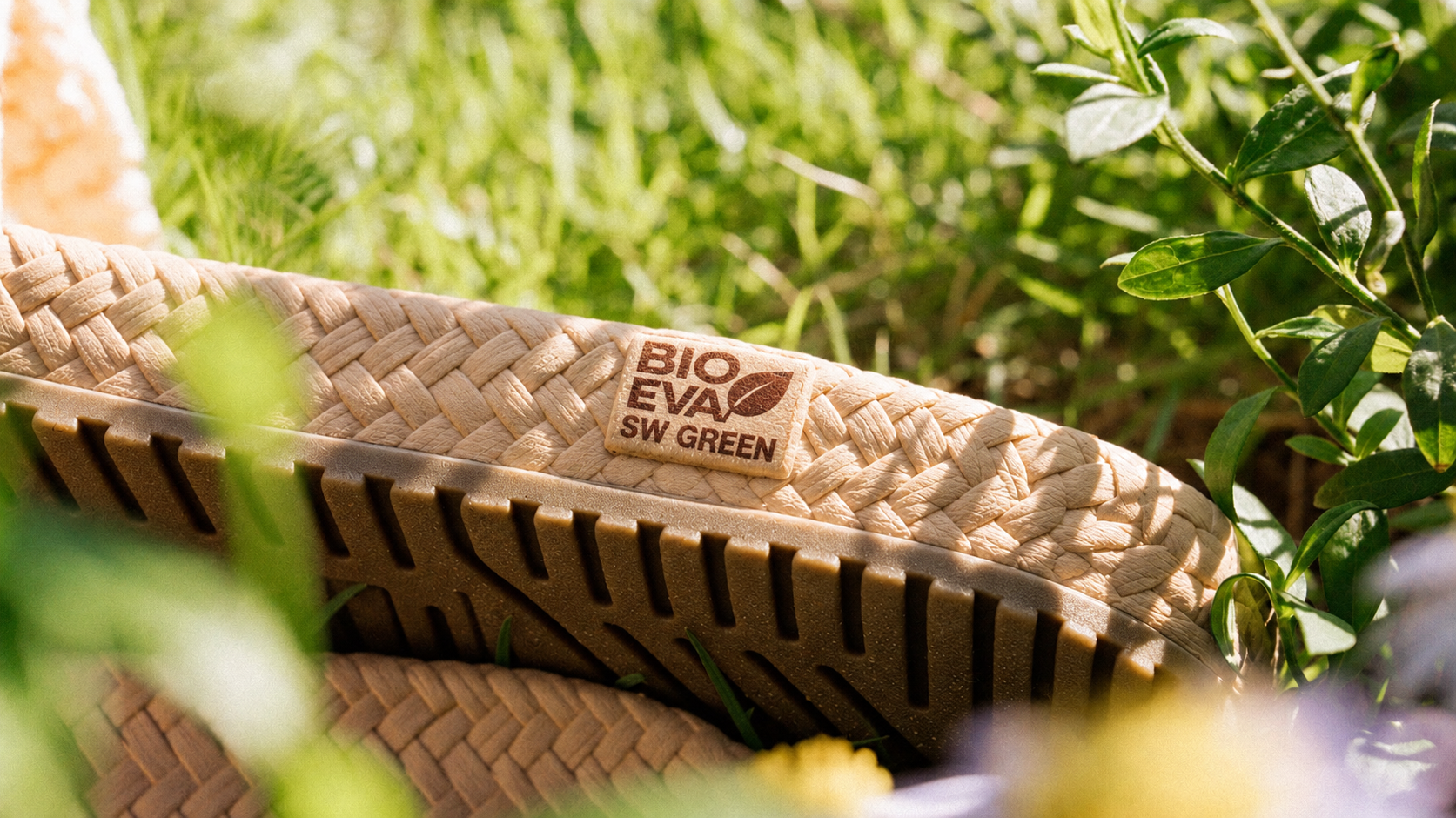
Sugarcane vs. Corn: What Do the Carbon Numbers Actually Tell Us?
Now, let’s look at the data.
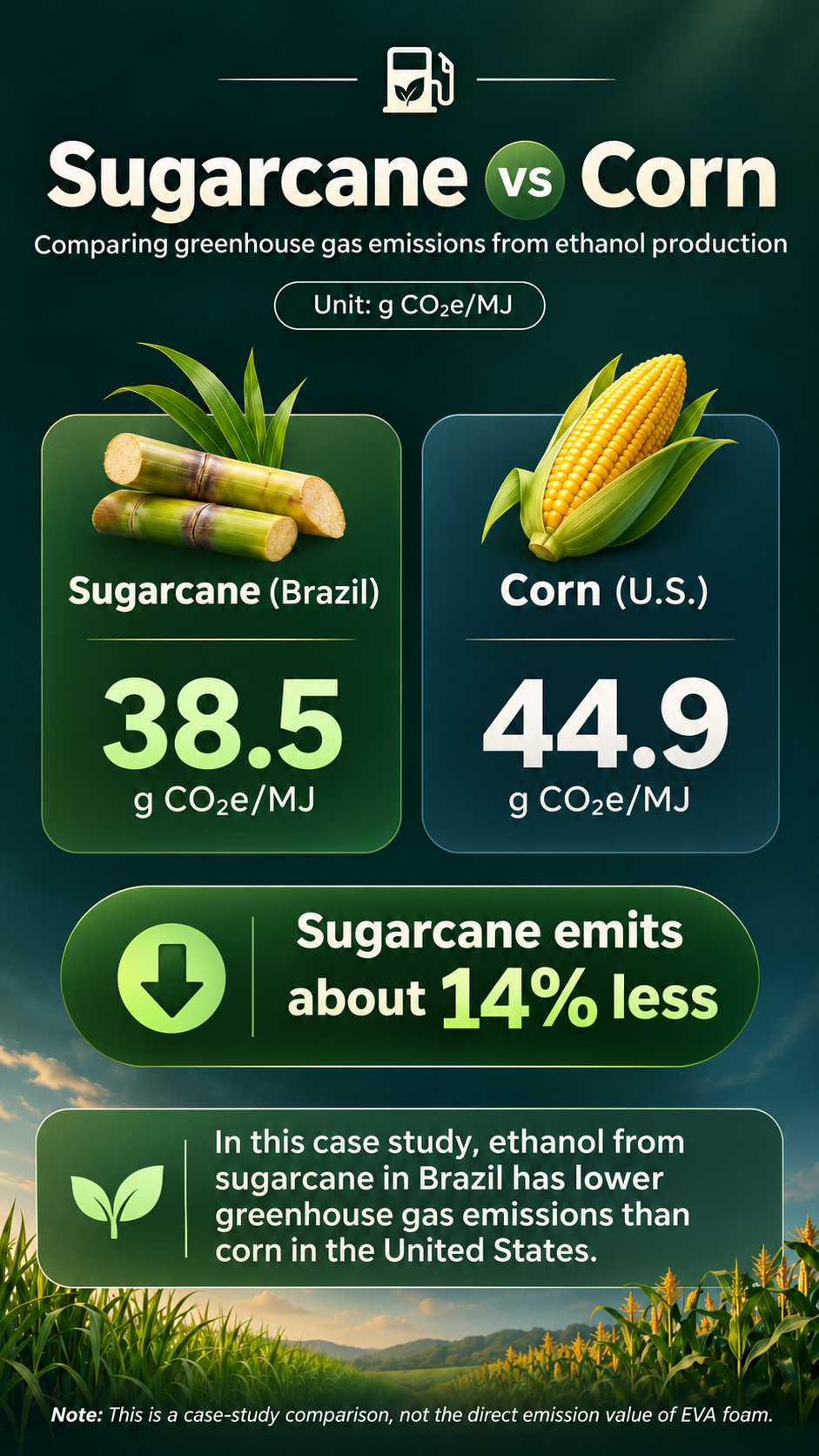
A 2018 study by Mekonnen and colleagues, published in Environmental Science & Technology, examined the water, energy, and carbon footprints of ethanol production from corn in the United States and sugarcane in Brazil.
The results revealed an interesting difference.
Sugarcane ethanol (Brazil): 38.5 g CO₂e/MJ
Corn ethanol (United States): 44.9 g CO₂e/MJ
In this comparison, sugarcane-based ethanol had approximately 14% lower greenhouse gas emissions than corn-based ethanol.
That’s a meaningful finding, but context is everything.
The researchers examined production systems in two different countries, each with its own climate, agricultural practices, energy sources, and industrial infrastructure.
So these results don’t prove that every sugarcane field has a lower carbon footprint than every cornfield.
They also don’t mean that sandals made with Bio-based EVA automatically produce 14% fewer emissions.
The study focused on ethanol production, not the complete life cycle of EVA foam or a finished pair of sandals.
To calculate the environmental impact of footwear, we would need to consider additional stages, including polymer production, foam manufacturing, other components, transportation, product use, and end-of-life management.
That’s why Life Cycle Assessment (LCA) is such an important tool for evaluating sustainability claims.
Good intentions are a starting point. Reliable measurements help us understand the actual results.
But Wait, Doesn’t Sugarcane Have Environmental Downsides Too?
Absolutely.
And this is where the conversation gets more interesting.
Just because a material comes from plants doesn’t mean it has no environmental impact.
Sugarcane cultivation still requires land, water, fertilizers, and agricultural energy.
In some regions, burning sugarcane before harvesting also contributes to air pollution.
Thailand, for example, continues to face challenges associated with agricultural burning and PM2.5 pollution.
Expanding sugarcane plantations without proper land-use management can also put pressure on ecosystems.
There’s another surprising detail in the same 2018 study.
Although sugarcane-based ethanol in Brazil showed a lower carbon footprint, it had a higher water footprint than corn-based ethanol in the United States.
The study reported approximately:
- Sugarcane ethanol: 1,115 liters of water per liter of ethanol
- Corn ethanol: 541 liters of water per liter of ethanol
That doesn’t make sugarcane a bad material.
It simply shows why environmental performance cannot be measured using carbon emissions alone.
One crop may perform better in one category while creating greater impacts in another.
Cassava, for example, also has significant potential as an ethanol feedstock, particularly in tropical countries with suitable farming conditions and processing infrastructure.
So perhaps the more useful question isn’t, “Which plant is the most sustainable?”
It’s this:
Where does the material come from, how is it produced, and what environmental impacts does it create along the way?
Those are the questions that help turn sustainability from a marketing message into something we can actually evaluate.
Bio-Based Doesn’t Mean Biodegradable. Here’s Why That Matters.
This is one of the biggest misunderstandings surrounding alternative materials.
The words bio-based and biodegradable might sound similar, but they describe different things.
Bio-based refers to a material made partly or entirely from biological resources.
Biodegradable describes a material that can break down through biological processes under specific conditions.
A material can be bio-based without being biodegradable.
Bio-based EVA is a good example.
Although some of its raw materials may come from sugarcane, its chemical structure and performance can be similar to conventional EVA.
That doesn’t mean it will naturally disappear into the soil after use.
According to Braskem, grades in its I’m green™ Bio-based EVA portfolio contain approximately 45–80% bio-based carbon, depending on the grade, as measured using ASTM D6866.
These figures describe specific resin materials, not necessarily the bio-based content of every finished sandal.
The distinction matters.
Using Bio-based EVA can reduce reliance on fossil-based feedstocks, but it does not automatically make a product biodegradable, carbon-neutral, or completely sustainable.
Clear communication is important because consumers deserve to understand what a material actually does, not just what its name suggests.

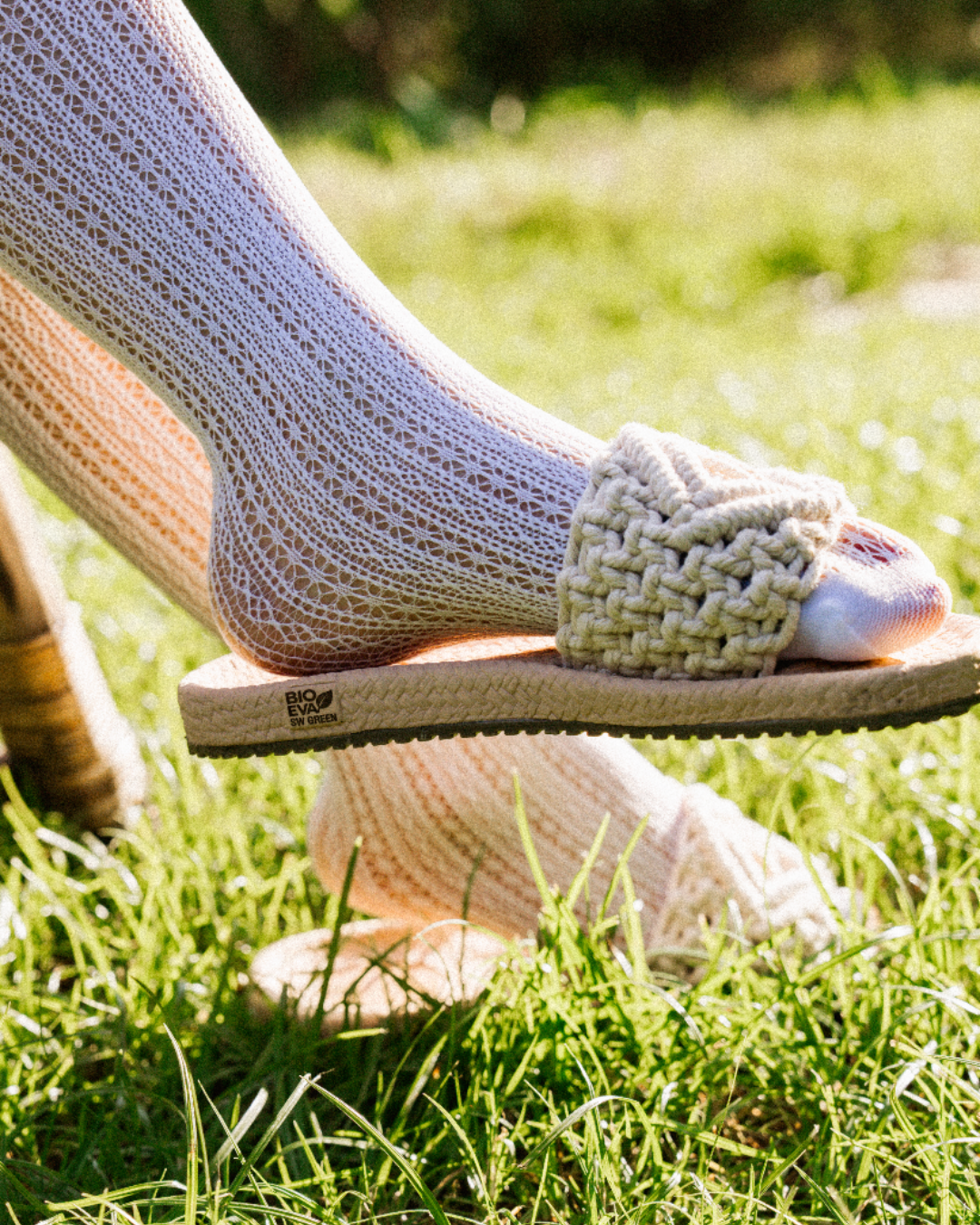
Sandals World: Changing the Materials Without Losing the Craft
Let’s bring the story back to footwear.
Think about what makes handmade sandals special.
The colors, textures, knots, embroidery, and carefully crafted details all tell a story about the people who created them.
Behind each pair is a combination of creativity, skill, and time.
These are the qualities Sandals World wants to celebrate and preserve.
But there’s another side to every pair of sandals that people rarely notice.
The materials underneath the craftsmanship.
The foam supporting your feet. The outsole making contact with the ground. The components that influence how a sandal feels and performs.
These materials deserve just as much attention as the design itself.
That’s part of the thinking behind BIO EVA SW GREEN, a material development initiative from Sandals World.
The project explores the use of Bio-based EVA made with renewable feedstocks such as sugarcane, with the goal of reducing dependence on fossil-derived raw materials.
The idea isn’t to replace the identity of Thai handmade sandals.
It’s to explore how material innovation can support the future of traditional craftsmanship.
For Sandals World, handmade products are about more than beautiful patterns.
Design, comfort, materials, and craftsmanship all contribute to the value of a finished product.
This perspective connects naturally with the development of Artistic Handmade Sandals and Art & Craft Sandals, where creative expression and everyday functionality come together.
At the same time, exploring alternative materials opens up a broader conversation about the future of Thailand sandals.

How can local craftsmanship continue to evolve?
How can new technologies support traditional skills without losing their cultural identity?
And how can material innovation become part of a more responsible approach to production?
If the goal is to move toward Sustainable Thai Craft Sandals, beautiful design alone won’t be enough.
Understanding material origins, manufacturing standards, product durability, and end-of-life management matters too.
Better Materials Are a Starting Point, Not the Finish Line
People choose sandals for all kinds of reasons.
Some fall in love with the design.
Others care most about comfort, durability, or the feeling of supporting handmade products.
Meanwhile, a growing conversation around responsible fashion is encouraging consumers to pay more attention to the materials and production processes behind what they buy.
But choosing a bio-based material doesn’t automatically guarantee the lowest environmental impact.
Durability matters.
A well-made pair of sandals that lasts longer may help reduce the need for frequent replacements.
Repairability, reuse, and responsible end-of-life management are also important parts of the bigger picture.
That’s why the story of sugarcane should be seen as one chapter in the material journey, not the final destination.
Through SW GREEN, Sandals World is exploring how alternative materials might contribute to a more thoughtful approach to footwear.
Not simply by making sandals look different, but by questioning the materials used to create them in the first place.
After all, meaningful innovation doesn’t always need to be visible.
Sometimes it begins long before the product reaches our feet.
From Sugarcane Fields to the Future of Thai Handmade Sandals
Sugarcane isn’t an interesting material because it’s the most environmentally friendly plant on Earth.
It’s interesting because it combines several valuable characteristics.
Its sugars are suitable for ethanol production. Its agricultural by-products can support energy generation. And established industrial technologies already allow sugarcane-derived ethanol to become a feedstock for Bio-based EVA.
These advantages make sugarcane a promising option for reducing reliance on certain fossil-based materials.
Still, responsible sourcing, environmental management, and transparent impact assessment remain essential.
For Sandals World, developing handmade sandals is about looking beyond the details people see on the surface.
It’s also about understanding what lies beneath them.
The origins of the materials. The decisions involved in production. And the opportunities to make more thoughtful choices as technology evolves.
The next chapter of fashion might not begin with a completely new design.
It might begin with a simple question:
What if we could rethink the materials we already use?
Because protecting the future of Thai craftsmanship isn’t only about preserving what makes it special today.
It’s also about being open to better possibilities tomorrow.
Same Craft. New Sole. Greener Future.

𝙎𝙖𝙣𝙙𝙖𝙡𝙨 𝙒𝙤𝙧𝙡𝙙 𝙞𝙨 𝙏𝙝𝙖𝙞𝙡𝙖𝙣𝙙’𝙨 𝙡𝙖𝙧𝙜𝙚𝙨𝙩 𝙝𝙪𝙗 𝙤𝙛 𝙖𝙧𝙩𝙞𝙨𝙩𝙞𝙘 𝙝𝙖𝙣𝙙𝙢𝙖𝙙𝙚 𝙨𝙖𝙣𝙙𝙖𝙡𝙨


ABOUT THE CONTENT CREATOR
BUNTHARIK INSIRI
(Content Writer)
Sandals World | Art & Craft Sandals | Sustainable Thai Craft Sandals Tags: handmade sandals, sandals world, foot health,
Thailand sandals, artistic handmade sandals, art & craft sandals, plantar fasciitis, bunion, sustainable sandals and BIO EVA ,SW GREEN
References
- Mekonnen, M. M., et al. (2018). Water, Energy, and Carbon Footprints of Bioethanol from the U.S. and Brazil. Environmental Science & Technology. Research Paper
- OECD-FAO (2025). Agricultural Outlook 2025–2034: Sugar. Full Report
- Braskem. I’m green™ Bio-based Portfolio. Material Information
- Braskem (2025). Updated Life Cycle Assessments for I’m green™ Bio-based Portfolio. Read More


Thai Dress Adventure 2026: Explore Bangkok, Discover Thai Culture & Style Your Day with VPADA BANGKOK
Views: 5 VPADA BANGKOK Dress Thai, Walk VPADA! — Thai Charm in Every Step. Café [...]
Nov

Where Does Our Waste Really Go? And How Long Can We Keep Living This Way?
Views: 21 As environmental challenges become impossible to ignore, Sandals World is taking a small [...]
Nov
From Oil to Sugarcane: How Plastic Materials Are Changing the Future of Handmade Sandals
Views: 24 Fossil-Based Plastic vs. Bio-Based EVA: A New Material Choice for Handmade Sandals Have [...]
Nov

Milala Handmade at POPUPASIA 2026: Every Knot Tells a Story, Every Connection Matters
Views: 45 More Than Sandals. A Story of Craftsmanship, Love, and the People Who Make [...]
Nov

Thailand Tourism 2026: Fewer Tourists, But Is Thailand Entering a New Era of Travel?
Views: 22 Fewer international visitors, changing spending patterns, and a growing focus on meaningful experiences. [...]
Nov

Milala Handmade: From a Simple Knot to Handmade Sandals Loved Around the World | The Power of Knot
Views: 16 Have you ever picked up a pair of beautiful sandals and wondered how [...]
Nov

LOy Krathong, LOve Thai Style! Celebrate Thai Culture, Express Your Style, and Craft Happy Memories with VPADA
Views: 93 Who says traditional Thai fashion is only for special occasions? And who says [...]
Nov
SANDALS WORLD GUIDE



Artistic Handmade Sandals
BY
SANDALS WORLD THAILAND
The Largest Hub
of Artistic Handmade Sandals in Thailand.