

Sandals World News, Sustainability
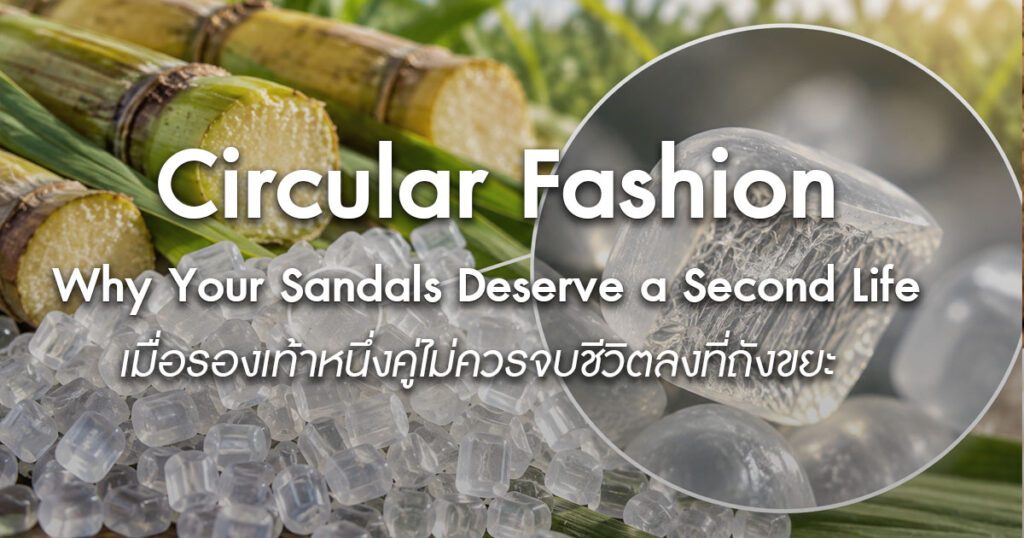
Circular Fashion: Why Your Sandals Deserve a Second Life
Sep
What happens to your favorite pair of sandals when you stop wearing them? At first, this may sound like a small question. However, when the world produces billions of pairs of shoes every year, the answer becomes an important environmental and business issue.
For years, the fashion industry often connected sustainability with recycled materials, natural fibers, or bio-based alternatives. Today, the conversation goes much further. Brands now need to consider how long a product can last, whether customers can repair it, and what happens when it reaches the end of its first life.
This new way of thinking sits at the heart of Circular Fashion. More importantly, it could define the next chapter of SW GREEN by Sandals World.
From Take-Make-Waste to a Circular Economy
Traditional manufacturing usually follows a simple linear model: Take → Make → Use → Waste. Companies extract resources, turn them into products, sell them, and eventually discard them.
Although this system supported industrial growth for decades, it also created a major challenge. Resources continue to move out of nature, while waste keeps building up at the other end of the system.
Circular Economy offers a different approach: Design → Make → Use → Care → Repair → Reuse → Remake → Recover.
Instead of focusing only on better waste management, circular design aims to prevent valuable products and materials from becoming waste too quickly. For sandals, this shift changes the questions designers ask from the beginning.
Can customers repair the sandal? Could they replace one worn component instead of throwing away the whole pair? Can manufacturers recover useful materials after use?
Most importantly, can the product remain valuable for longer? These questions show why Circular Fashion is moving beyond a temporary trend and becoming a practical business model.
Why Circular Fashion Matters to the Footwear Industry
The footwear industry faces a unique circularity challenge because a single shoe can contain foam, rubber, textiles, adhesives, decorative materials, and synthetic components.
Manufacturers often bond these materials tightly together. As a result, separating them after use becomes difficult and sometimes uneconomical.
Recycling alone, therefore, cannot solve the problem. Brands need to consider the entire product life cycle, from the first design decision to the final stage of material recovery.
This challenge creates an especially interesting opportunity for handmade sandals. Unlike many mass-produced products, handmade footwear can carry additional value through craftsmanship, human skill, local knowledge, and cultural identity.
When only one part of a handmade sandal wears out, throwing away the entire product can also mean throwing away craftsmanship that still has value. Circular design offers another possibility: preserve what still works and replace only what no longer works.

Recycling Should Not Be the First Solution
Many people still associate Circular Economy mainly with recycling. However, recycling should often come later in the circular hierarchy.
Imagine a pair of handmade sandals with a worn outsole but a beautiful macramé upper that remains in excellent condition. A conventional system might discard or process the whole pair.
By contrast, a circular system could keep the handmade upper, restore the craftwork, replace the worn sole, and return the sandal to use.
This approach preserves more value because it retains materials, labor, design, and craftsmanship. Therefore, a stronger circular hierarchy looks like this:
Use Longer → Repair → Reuse → Remake → Recover Materials
In other words, the best waste may be the waste we prevent from appearing in the first place.

Sandals World: Sustainability Starts with Better Design
For Sandals World, Circular Economy fits naturally with the existing product philosophy. The brand already focuses on three core strengths: Design + Materials + Comfort.
Together, these elements can form the foundation of a broader sustainability strategy. Rather than treating environmental responsibility as an extra feature, Sandals World can integrate it into the product from the first sketch to the final stage of use.
That shift matters because sustainable design works best when it starts before production, not after a product becomes waste.
Handmade Design Can Create Emotional Durability
One of the strongest characteristics of Sandals World comes from its connection to handmade craftsmanship and local communities.
Techniques such as macramé, crochet, embroidery, weaving, and regional patterns can transform traditional knowledge into contemporary Art & Craft Sandals.
Craftsmanship, however, offers more than visual beauty. It can also create emotional value.
When customers understand who made a product, where the craft came from, and what the design represents, they may develop a stronger relationship with that product. Designers often describe this idea as emotional durability.
As a result, customers may care for their sandals longer, repair them instead of replacing them, and think twice before throwing them away.
For this reason, Artistic Handmade Sandals can become an important part of Circular Design. The craftsmanship itself gives customers a reason to preserve the product.
BIO EVA and Thai Natural Rubber: A Better Starting Point
Materials form the second pillar of SW GREEN. Sandals World has explored BIO EVA made from renewable feedstocks such as sugarcane as an alternative to relying entirely on fossil-based raw materials.
In simple terms, the pathway can move from:
Sugarcane → Bio-Ethanol → Bio-Ethylene → BIO EVA → Sandal Footbed
This approach can reduce dependence on fossil feedstocks. Furthermore, verified bio-based material systems may offer lower carbon impacts depending on their production process, energy source, supply chain, and life-cycle assessment.
Nevertheless, one distinction remains essential: BIO EVA does not automatically mean biodegradable.
Bio-based describes the origin of the carbon feedstock. Biodegradable, on the other hand, describes how a material breaks down under specific biological conditions.
Therefore, Sandals World should not stop the sustainability story at “made from sugarcane.” The next question should be more important: How can we keep this material useful after the customer stops wearing the sandals?
The same principle applies to Thai natural rubber. Natural rubber strengthens the connection between renewable materials and the identity of Thailand sandals. Yet a natural material alone does not create a Circular Economy.
Ultimately, the system around that material determines whether it can remain valuable.
Comfort Can Support Sustainability Too
Comfort may sound unrelated to environmental sustainability. In practice, however, it can influence how long and how often people use a product.
Consider two pairs of sandals. The first pair looks beautiful but feels uncomfortable, so the owner wears it only a few times. The second pair combines attractive design with everyday comfort, so the owner reaches for it repeatedly.
Although both products may require similar resources during production, their value per wear differs significantly.
For this reason, Sandals World focuses on features such as a contoured footbed that follows the natural shape of the foot and a rubber outsole designed to provide grip for everyday use.
Greater comfort can encourage more frequent use. Consequently, the sustainability conversation can move beyond carbon per pair toward a more meaningful idea: carbon per wear.
The longer and more often customers use a product, the more value they receive from the materials and energy that created it.

Now imagine the next stage of Sustainable Thai Craft Sandals. A customer wears a pair for several years. Eventually, the outsole begins to wear down, but the handmade macramé upper remains beautiful.
Instead of throwing the sandals away, the customer sends them back to Sandals World.
A circular service could then follow a simple process:
Return → Inspect → Clean → Repair → Replace → Reuse
Craftspeople could preserve the original handmade upper, repair damaged details, replace the worn footbed or outsole, and return the sandals to everyday life.
This system protects more than raw materials. It also preserves time, skill, memories, and human craftsmanship.
A simple idea captures the concept clearly: The Craft Lives On.
For a brand built around handmade work, this principle can create both environmental and emotional value.

Can Sustainable Thai Craft Sandals Have More Than One Life?
Now imagine the next stage of Sustainable Thai Craft Sandals. A customer wears a pair for several years. Eventually, the outsole begins to wear down, but the handmade macramé upper remains beautiful.
Instead of throwing the sandals away, the customer sends them back to Sandals World.
A circular service could then follow a simple process:
Return → Inspect → Clean → Repair → Replace → Reuse
Craftspeople could preserve the original handmade upper, repair damaged details, replace the worn footbed or outsole, and return the sandals to everyday life.
This system protects more than raw materials. It also preserves time, skill, memories, and human craftsmanship.
A simple idea captures the concept clearly: The Craft Lives On.
For a brand built around handmade work, this principle can create both environmental and emotional value.
Design for Disassembly Could Change the Future of Sandals
To make repair and recovery easier, Sandals World could eventually explore Design for Disassembly.
Today, many footwear products use strong adhesives to permanently bond several materials together. While this construction can improve product strength, it also creates difficulties when customers need to repair, separate, or recover components.
Future product development could therefore examine a modular structure such as:
Reusable Handmade Upper → Replaceable BIO EVA Footbed → Replaceable Natural Rubber Outsole
With this system, customers would not need to discard the entire sandal because one part had worn out.
Instead, maintenance and replacement could extend the product’s life. Moreover, modular construction could help Sandals World preserve valuable handmade components for much longer.
SW GREEN Take-Back: When Sandals Come Home
A future SW GREEN Take-Back Program could create another layer of circularity.
When customers stop using their sandals, they could return them to Sandals World for evaluation. The brand could then direct each pair toward the most valuable possible next step.
Grade A — Reuse: Clean and inspect sandals that remain in good condition, then prepare them for a second life.
Grade B — Repair: Fix damaged straps, craft elements, footbeds, or outsoles and return the product to use.
Grade C — Remake: Recover valuable handmade components from sandals that can no longer function in their original form and transform them into new products.
Grade D — Material Recovery: Separate usable foam, rubber, textile, and other components where technically possible and direct them into suitable recovery channels.
Finally, only materials that genuinely have no remaining use should become residual waste.
This approach moves sustainability far beyond simply adding a recycling bin inside a store.

Circular Economy Can Create New Business Opportunities
Circular Fashion does not have to create only additional costs. On the contrary, it can generate new services and strengthen long-term customer relationships.
For example, Sandals World could develop a Repair Service for straps and handmade details. A Refresh Service could focus on cleaning and craft restoration, while a Resole Service could replace worn footbeds and outsoles.
In addition, a Remake Service could combine original craft elements with new components. Meanwhile, a Trade-In Program could encourage customers to return old products.
An SW Reborn Collection could also transform recovered handmade pieces into limited-edition designs.
Consequently, the relationship between brand and customer would no longer end at checkout. Sandals World could remain connected
From SW GREEN to a Circular Thai Craft Footwear System
SW GREEN can evolve step by step.
SW GREEN 1.0 — Better Materials: Sugarcane-based BIO EVA + Thai natural rubber.
SW GREEN 2.0 — Better Products: Beautiful Design + Thoughtful Materials + Comfort + Durability.
SW GREEN 3.0 — Circular Products: Repair + Replace + Reuse + Remake + Recover.
SW GREEN 4.0 — Circular Ecosystem: Maker → Sandals World → Customer → Repair → Take-Back → Remake → Material Recovery → Maker.
Through this development, Sustainable Thai Craft Sandals could represent much more than environmentally conscious materials.
They could represent a complete system that considers the maker, community, design, comfort, product life, and end-of-life strategy together.
What Happens to Your Sandals After You Stop Wearing Them?
This question could define the next phase of SW GREEN.
The future of sustainability may not depend only on which brand discovers the newest material. Instead, it may depend on which brands can preserve product value for the longest time.
Sandals World has an opportunity to connect handmade sandals, local craftsmanship, bio-based materials, comfort, Thai identity, and Circular Economy principles into one clear direction.
Artistic Handmade Sandals can celebrate the hands behind each product, while Art & Craft Sandals can connect contemporary design with local knowledge.
Meanwhile, Sustainable Thai Craft Sandals can go one step further by considering not only how a product begins, but also what happens after its first life ends.
Ultimately, a truly circular pair of sandals should not move through the economy only once. Its materials, craftsmanship, and story should continue to create value for as long as possible.
Design to Last. Made to Repair. Created to Return. SW GREEN — The Second Life of Sandals.
𝙎𝙖𝙣𝙙𝙖𝙡𝙨 𝙒𝙤𝙧𝙡𝙙 𝙞𝙨 𝙏𝙝𝙖𝙞𝙡𝙖𝙣𝙙’𝙨 𝙡𝙖𝙧𝙜𝙚𝙨𝙩 𝙝𝙪𝙗 𝙤𝙛 𝙖𝙧𝙩𝙞𝙨𝙩𝙞𝙘 𝙝𝙖𝙣𝙙𝙢𝙖𝙙𝙚 𝙨𝙖𝙣𝙙𝙖𝙡𝙨


ABOUT THE CONTENT CREATOR
BUNTHARIK INSIRI
(Content Writer)
Sandals World | Art & Craft Sandals | Sustainable Thai Craft Sandals Tags: handmade sandals, sandals world, foot health,
Thailand sandals, artistic handmade sandals, art & craft sandals, plantar fasciitis, bunion, sustainable sandals and BIO EVA ,SW GREEN
Circular Fashion: Why Your Sandals Deserve a Second Life
Post Views: 1 What happens to your favorite pair of sandals when you stop wearing [...]
Sep

Chic Handmade: From Fingertips to Every Step The Story Behind Artistic Handmade Sandals from Thailand
Post Views: 5 In a world where factories can produce thousands of shoes every day, [...]
Sep

From Thai Craft to BIO EVA: How Sandals World Is Rethinking the Future of Sandals
Post Views: 5 When people think about sandals, they often think about comfort, summer, travel, [...]
Sep
Bangkok Just Became Asia’s #2 Most Repeat-Visited City in 2026 Here’s Why It’s Time to Walk the City in Handmade Sandals from Thailand
Post Views: 11 Give Bangkok another round of applause! Agoda, the world’s leading digital travel [...]
Sep

Chiang Mai, a World-Class City and the Art & Craft Sandals Behind Its Charm
Post Views: 8 Chiang Mai is no longer just a beloved destination for Thai travelers [...]
Sep

From Oil Wells to Sugarcane Fields: How Sandals World Turns Handmade Sandals Into a Climate Solution
Post Views: 12 Every year, we burn fossil fuels for energy and manufacturing. As a [...]
Sep

One Pair, One Story: Find Handmade Sandals at White Market Chiang Mai
Post Views: 15 Chiang Mai turns a simple walk into a lasting memory. Some visitors [...]
Sep

VPADA Elephant Friends and Four Little Stories of Thailand
Post Views: 19 What if you could take Thailand’s mountain skies, blooming lotus ponds, and [...]
Sep
SANDALS WORLD GUIDE


Artistic Handmade Sandals
BY
SANDALS WORLD THAILAND
The Largest Hub
of Artistic Handmade Sandals in Thailand.