

Brand Stories
Recycling Is No Longer Enough: How Europe’s Circular Fashion Movement Is Changing the Future of Fashion
Oct
Europe discards approximately five million tonnes of clothing every year, yet only around 1% of clothing material returns to the market as new clothing. Could recycling alone ever solve fashion’s waste problem?
For years, recycled fabrics and environmentally conscious collections have dominated sustainability conversations. Many brands promote recycled polyester, recovered materials, and packaging made from waste.
However, recycling does not automatically solve the problems of overproduction, unnecessary consumption, and products that wear out too quickly.
Imagine a garment made from recycled fibres. A customer wears it several times before throwing it away. Although the original materials may have been recycled, the product still enters a system that continuously demands new resources.
In September 2026, European researchers and industry professionals explored this problem at the ECOSYSTEX Conference in Belgium.
Under the theme Circular Textiles Beyond Recycling, the event examined how the fashion industry could preserve product value for longer.
Meanwhile, the European Union has begun introducing regulations that encourage more responsible management of clothing and footwear.
Together, these developments raise a crucial question: What if the future of sustainable fashion begins long before a product reaches a recycling facility?

What Is Circular Fashion?
Traditional fashion frequently follows a linear model:
Take materials → Produce → Sell → Use → Discard
Circular Fashion explores a different approach:
Select materials thoughtfully → Design for durability → Produce responsibly → Use longer → Repair and reuse → Recover materials
The most important difference is where responsibility begins.
A linear system often focuses on waste management after consumers discard products. A circular system considers how businesses can reduce unnecessary waste before it occurs.
For example, a pair of sandals designed with suitable materials, durable construction, and practical care requirements may remain usable for longer than a poorly constructed alternative.
However, longevity does not automatically establish a lower environmental footprint. A reliable assessment must also consider manufacturing, materials, energy consumption, product use, and end-of-life management.
Circular Fashion does not eliminate the need for recycling. Instead, it places recycling within a broader system.
What Does the New Circular Fashion Approach Look Like?
Circular Fashion encourages businesses to move beyond the simple idea of turning waste into new materials.
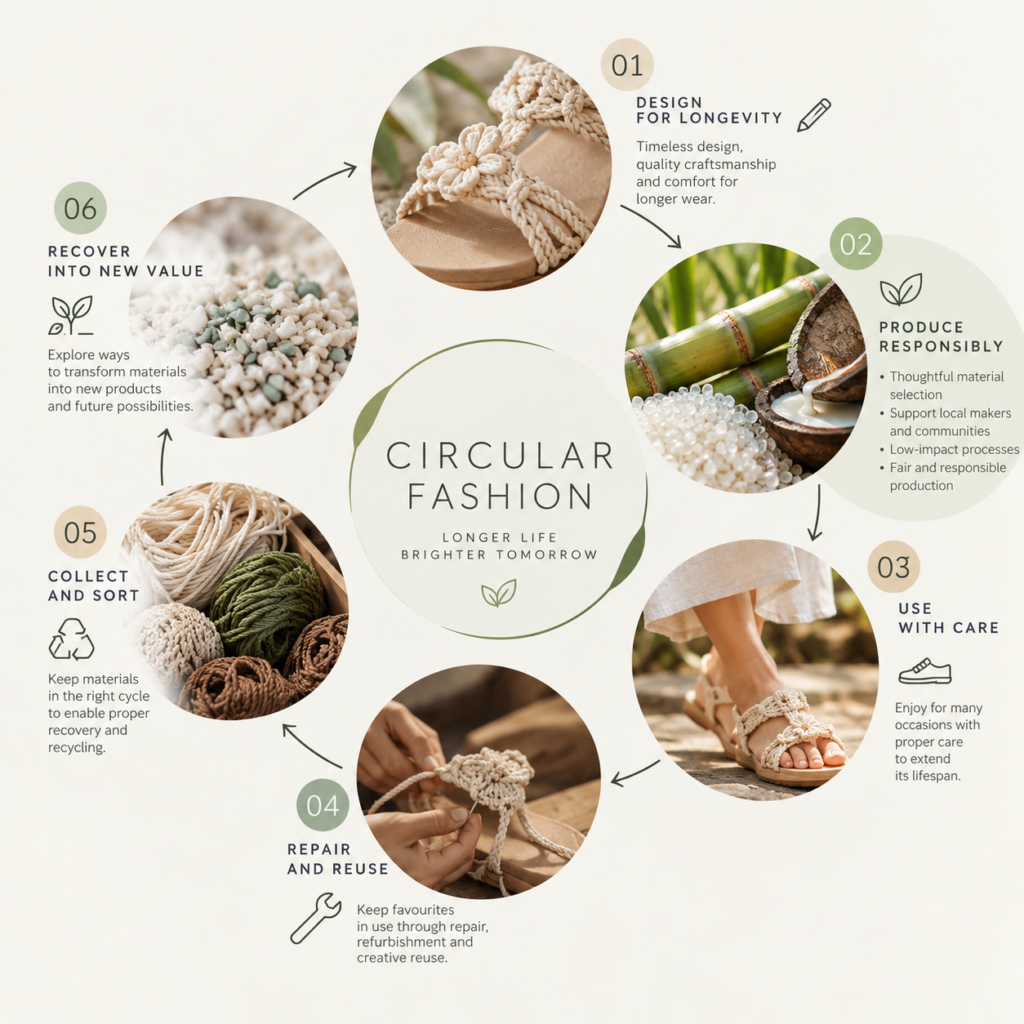
Its broader approach can be understood through six interconnected stages.
1. Design for Longevity
Manufacturers consider durability, construction, comfort, and practical maintenance from the earliest design stages.
Products should meet real consumer needs instead of depending exclusively on short-lived fashion trends.
2. Produce Responsibly
Responsible production begins with material selection.
Businesses can examine where materials originate, how manufacturers process them, and whether production creates avoidable waste.
Efficient resource management, suitable working conditions, and transparent information also support responsible production.
3. Use with Care
Proper maintenance can help consumers preserve their products.
Cleaning, storage, and appropriate usage may reduce premature damage and extend product life.
4. Repair and Reuse
Repair and reuse can keep valuable products in circulation.
However, feasibility depends on a product’s condition, construction, and safety requirements.
5. Collect and Sort
When products can no longer serve their original purpose, appropriate collection and material sorting become important.
Products containing multiple bonded materials may require specialised separation processes.
6. Recover into New Value
Where technically and environmentally appropriate, manufacturers may recover materials for recycling or other uses.
Nevertheless, not every material can be recycled indefinitely or returned to an equivalent product.
These stages highlight a central principle: preventing unnecessary waste deserves attention alongside improving recycling technology.
Photos of the ECOSYSTEX Conference 2026 by TextileETP.
What Happened at the ECOSYSTEX Conference 2026?
From September 22 to 24, 2026, Antwerp, Belgium, hosted the fourth ECOSYSTEX Conference in partnership with the University of Antwerp.
More than 130 professionals from research, industry, design, and policy attended the event.
ECOSYSTEX connects European research and innovation projects focused on sustainability and circularity in textiles.
Its 2026 programme explored circular business models, garment repair, reuse, sorting, material innovation, and workforce skills.
One notable example involved the CISUTAC project, which demonstrated semi-automated garment repair solutions in Antwerp.
The demonstration explored how businesses could make garment repair more efficient and accessible.
Another initiative, CRAFT-IT4SD, focused on revitalising craft sectors through innovation and sustainable development.
The event also introduced the Bioeconomy Innovation Strategy for the European Fibres, Textiles and Apparel Industry.
Furthermore, the TCLF Skills Observatory presented tools for understanding workforce requirements across the textile, clothing, leather, and footwear sectors.
These developments suggest that Circular Fashion requires more than better recycling facilities.
The industry also needs skilled workers, new technologies, responsible production systems, and viable business models.
However, these projects represent research, demonstrations, and emerging approaches. Their presentation does not mean the technologies are already available throughout the global fashion industry.
Why Is Recycling Alone Not Enough? The Statistics Behind Fashion Waste
The European Commission’s textile strategy provides important figures illustrating the scale of Europe’s clothing waste problem.
5 million tonnes — clothing discarded annually in the EU
This figure highlights the considerable quantity of clothing leaving use every year.
Approximately 12 kilograms — discarded clothing per person annually
The average illustrates how clothing waste connects to everyday consumption.
Only around 1% — clothing material recycled into new clothing
This figure is particularly significant because it highlights the limited scale of textile-to-textile recycling.
However, the 1% figure does not mean that the remaining 99% goes directly to landfill or incineration. Some textiles enter reuse systems or other recovery and disposal pathways.
Several challenges help explain why circularity remains difficult.
Modern garments often contain mixed fibres, dyes, elastane, coatings, and other components that complicate material separation.
Some recycling methods reduce fibre quality. Others require additional energy, chemicals, infrastructure, and investment.
Footwear can present similar challenges because manufacturers frequently combine textiles, rubber, foam, and adhesives.
Even if recycling improves, excessive production may continue consuming large amounts of virgin materials.
Therefore, the question is not whether society should abandon recycling.
Instead, why should the industry wait until products become waste before taking responsibility for the resources used to create them?
This question lies at the heart of Circular Fashion.
Beyond the Conference: New EU Rules Are Already Changing Fashion
Europe’s transition is not limited to research discussions.
The European Union is also developing regulations that address waste prevention, product information, and sustainable design.
The Ecodesign for Sustainable Products Regulation (ESPR) establishes a framework for sustainability requirements across several product categories.
Three milestones deserve particular attention.
2026: The EU Begins Banning the Destruction of Unsold Clothing and Footwear
On July 19, 2026, a prohibition on destroying unsold apparel, clothing accessories, and footwear began applying to large companies covered by EU rules.
The measure aims to prevent the unnecessary loss of products and the resources invested in their manufacture.
Businesses are encouraged to prioritise keeping usable goods in circulation through resale or preparation for reuse.
Significantly, under the ESPR definition, sending unsold goods directly to recycling can also count as destruction, unless a permitted exception applies.
Exceptions may cover circumstances such as product safety concerns or other qualifying conditions.
Medium-sized companies will become subject to the prohibition from July 19, 2030, while micro and small enterprises are exempt from this specific ban.
The message is significant: companies cannot necessarily treat recycling as an alternative to preserving the value of usable, unsold products.

2027: Digital Product Passports Could Improve Fashion Transparency
Another major development involves the Digital Product Passport (DPP).
The system aims to make relevant product information more accessible in digital form.
Depending on future product-specific requirements, this information could include material composition and other details relevant to product sustainability, use, or end-of-life management.
Such information may support consumers, repair services, recycling operators, and regulators.
The European Commission currently plans to adopt textile-specific rules under the ESPR in the fourth quarter of 2027.
However, this remains an indicative timeline.
It does not mean that every garment or footwear product must carry a Digital Product Passport immediately in 2027.
Further technical specifications, implementation measures, and applicable timelines will determine how the system operates.

2030: Europe’s Vision for Durable, Repairable, and Circular Textiles
The EU Strategy for Sustainable and Circular Textiles sets out a broader vision for 2030.
Europe wants textile products placed on its market to become more durable, repairable, and recyclable.
The strategy also aims to increase recycled fibre use, reduce hazardous substances, and improve environmental and social responsibility throughout the textile value chain.
Another objective involves making reuse and repair services more widely accessible and economically viable.
Importantly, this 2030 vision is not a single legal requirement that automatically applies to every product on one date.
Specific obligations depend on the relevant laws, delegated acts, and implementation schedules.
Nevertheless, the direction is clear: the European fashion sector is moving toward greater accountability for product design, material use, and waste prevention.
What Could Europe’s Circular Fashion Transition Mean for Thai Handmade Sandals?
As European sustainability policies evolve, businesses selling internationally may face increasing expectations around material information, product quality, and traceability.
For manufacturers of Thailand sandals and handmade sandals, this transition presents both opportunities and challenges.
Traditional Thai craftsmanship offers distinctive design techniques, creative value, and cultural knowledge.
However, handmade production does not automatically guarantee lower environmental impacts.
Businesses need reliable information about materials, production processes, quality, and appropriate end-of-life options.
By combining craftsmanship with responsible manufacturing practices, producers may develop stronger product value and more credible sustainability communication.
Sandals World: Responsible Production Starts with Material Choices
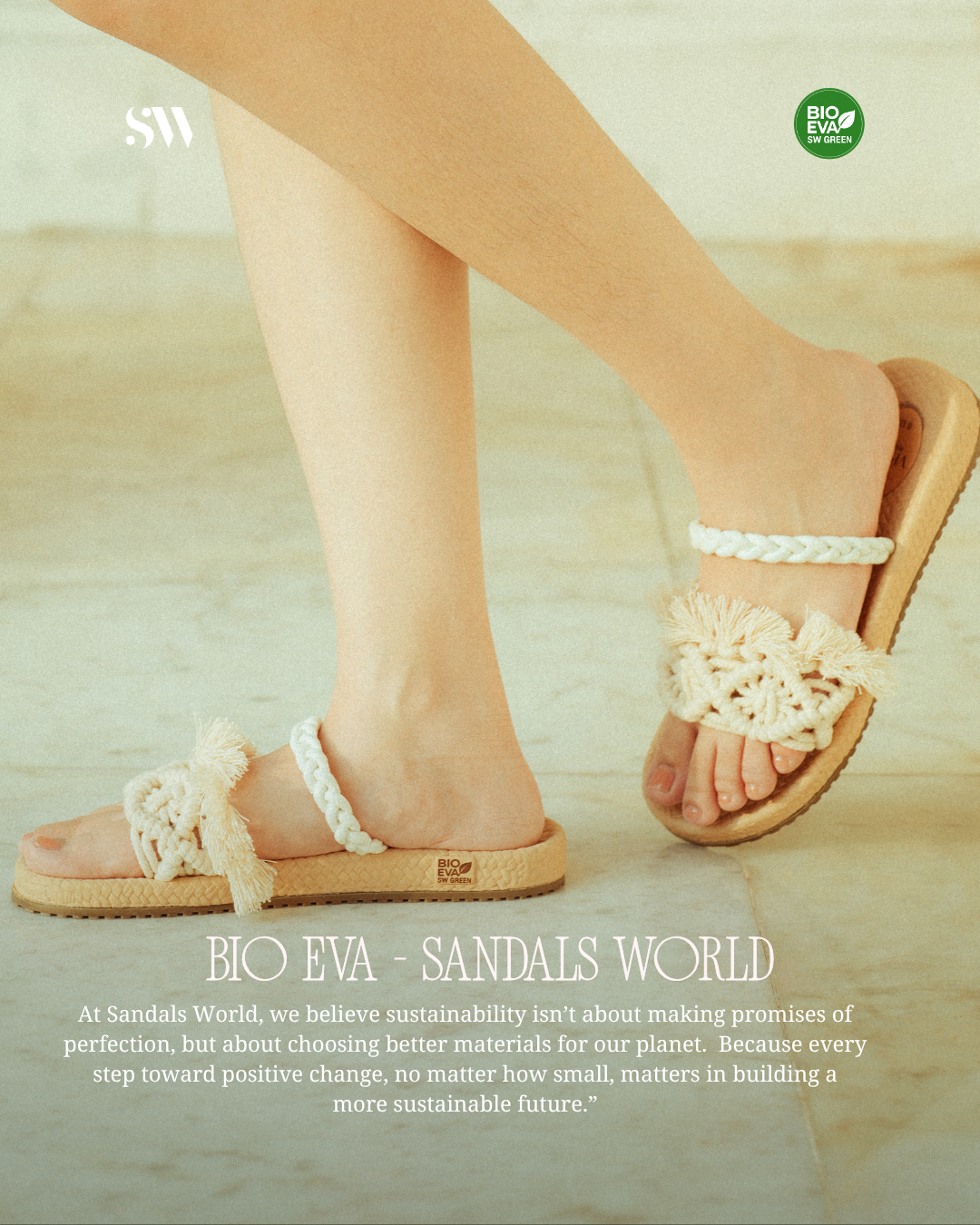
For Sandals World, the Circular Fashion discussion reflects the importance of considering materials and production practices from the beginning.
Through its vision of Sustainable Thai Craft Sandals, Sandals World connects contemporary footwear design with Thai craftsmanship, local makers, and ongoing material development.
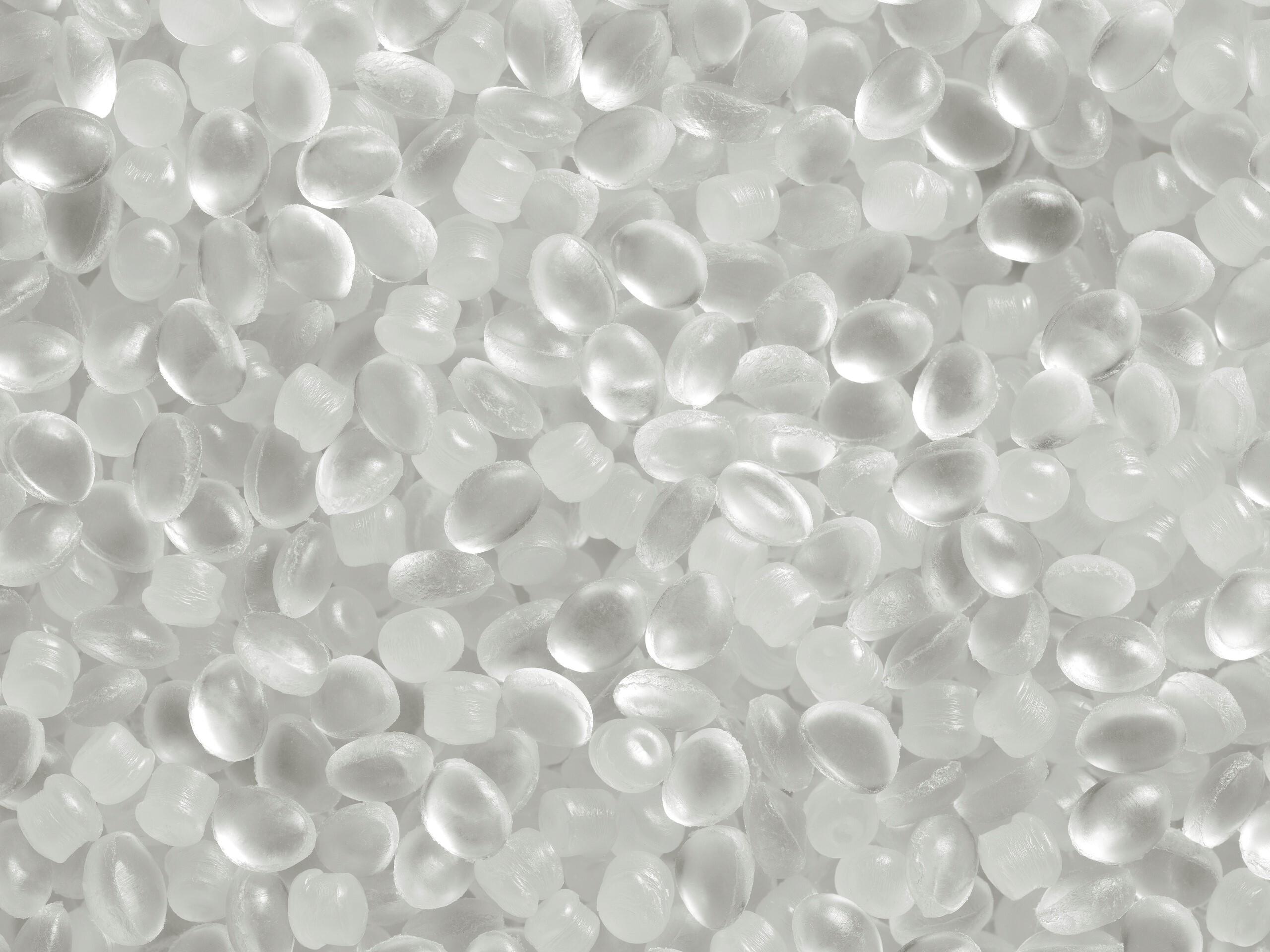
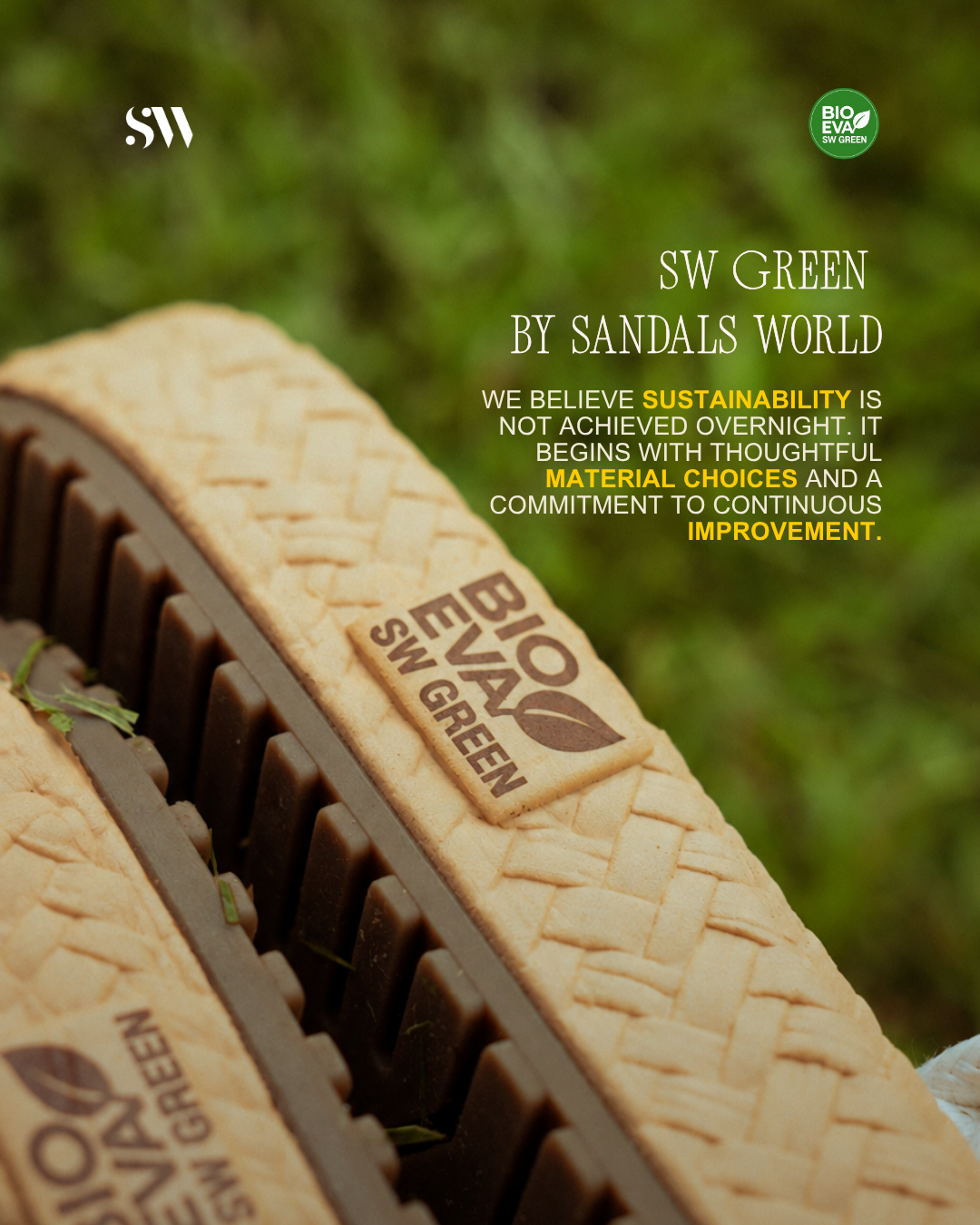
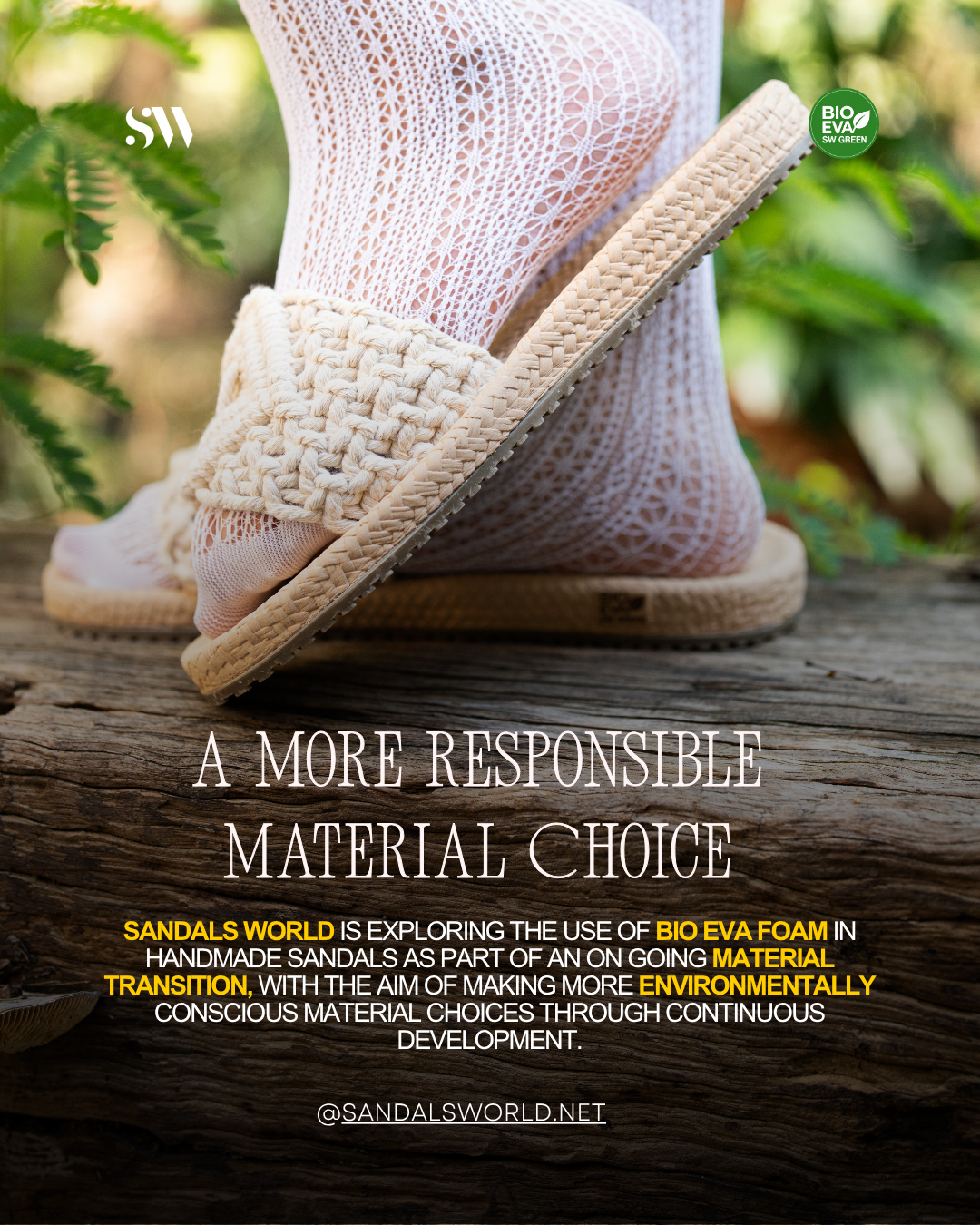
One area under exploration is BIO EVA, an EVA foam containing bio-based feedstock.
Depending on its composition, this material may partially replace fossil-derived inputs with renewable feedstocks.
However, BIO EVA is not automatically biodegradable, and its use does not prove that a complete pair of sandals has a lower carbon footprint.
Environmental comparisons require reliable evidence about material composition, manufacturing processes, product performance, and lifecycle impacts.
Sandals World therefore approaches BIO EVA as part of an ongoing Material Transition, rather than a claim of zero environmental impact.
Meanwhile, Artistic Handmade Sandals and Art & Craft Sandals offer opportunities to preserve traditional skills through contemporary design.
Macramé, crochet, and other handmade techniques can connect products with local craftsmanship and community knowledge.
Together, these ideas illustrate how creativity, responsible material development, and cultural identity can contribute to a broader sustainability conversation.
The Future of Circular Fashion Begins Before Recycling
The ECOSYSTEX Conference 2026 and evolving EU regulations highlight a fundamental change in the industry’s sustainability conversation.
Recycling remains important, but it cannot independently address problems created by overproduction, short product lifespans, and inefficient material use.
Circular Fashion encourages companies to consider the entire lifecycle of their products.
It begins with thoughtful design and material selection, continues through responsible production and careful use, and extends to repair, reuse, and material recovery.
For Sandals World, this discussion raises a simple but meaningful question:
“Before creating a pair of sandals, have we made responsible choices about the materials and resources it requires?”
The future of sustainable fashion may depend less on how much waste we can recycle and more on how thoughtfully we create, use, and preserve the products already in our world.
Sustainability Begins with Thoughtful Material Choices.
𝙎𝙖𝙣𝙙𝙖𝙡𝙨 𝙒𝙤𝙧𝙡𝙙 𝙞𝙨 𝙏𝙝𝙖𝙞𝙡𝙖𝙣𝙙’𝙨 𝙡𝙖𝙧𝙜𝙚𝙨𝙩 𝙝𝙪𝙗 𝙤𝙛 𝙖𝙧𝙩𝙞𝙨𝙩𝙞𝙘 𝙝𝙖𝙣𝙙𝙢𝙖𝙙𝙚 𝙨𝙖𝙣𝙙𝙖𝙡𝙨


ABOUT THE CONTENT CREATOR
BUNTHARIK INSIRI
(Content Writer)
Sandals World | Art & Craft Sandals | Sustainable Thai Craft Sandals Tags: handmade sandals, sandals world, foot health,
Thailand sandals, artistic handmade sandals, art & craft sandals, plantar fasciitis, bunion, sustainable sandals and BIO EVA ,SW GREEN
Recycling Is No Longer Enough: How Europe’s Circular Fashion Movement Is Changing the Future of Fashion
Post Views: 1 Europe discards approximately five million tonnes of clothing every year, yet only [...]
Oct

How Much Can One Tourist Contribute to a Local Community? Thailand’s Shift Beyond Visitor Numbers
Post Views: 16 How Much Does One Tourist Contribute to a Local Community? Thailand’s Tourism [...]
Oct

BIO EVA: A Material Transition for Handmade Sandals
Post Views: 20 Material Transition A Thoughtful Shift Toward More Responsible Materials Can a pair [...]
Oct

Milala Handmade Mini Heart Collection: A Small Heart with a Big Journey to Tainan
Post Views: 14 Big journeys do not always begin with something loud or dramatic. Sometimes, [...]
Oct

From Sacred Thai Garlands to Modern Hair Fashion: The Heritage Behind MALAI IN MOTION
Post Views: 15 MALAI IN MOTION WITH HANDMADE SANDALS BY SANDALS WORLD “Twisting Thai Garlands, [...]
Oct

VPADA Handmade Sandals October 2026: One Catalog, Endless Ways to Express Yourself
Post Views: 17 What if the perfect pair of sandals could say more about your [...]
Oct

What Is BIO EVA? Can Sugarcane Plastic Save the Planet?
Post Views: 21 Every time we buy a new pair of sandals, we may unknowingly [...]
Oct

Are Your Sandals Harming the Planet Before You Even Wear Them? The BIO EVA Revolution
Post Views: 26 What if your favorite pair of sandals had already left an environmental [...]
Oct
SANDALS WORLD GUIDE
Artistic Handmade Sandals
BY
SANDALS WORLD THAILAND
The Largest Hub
of Artistic Handmade Sandals in Thailand.